
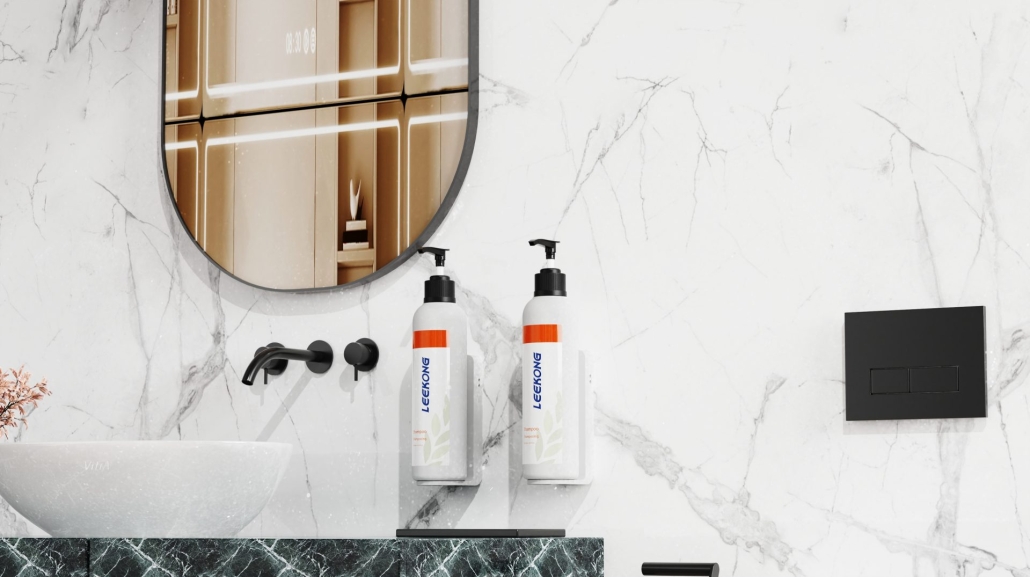
Five Key Considerations for Purchasing Soap dispensers in the Hotel/Catering Industry
A Comprehensive Procurement Guide: From Cost Control to Brand Experience
Introduction
In the hotel and catering industry, the restroom experience is often overlooked, yet it remains one of the key touchpoints shaping guests ‘brand impressions. A U.S. hotel industry survey reveals that over 70% of guests believe restroom cleanliness directly influences their overall hotel rating. Within restrooms, soap dispensers—being high-frequency fixtures—convey the brand’s values and professionalism through their quality, design, reliability, and sustainability.
However, faced with the overwhelming variety of soap dispensers available on the market—differing in material, capacity, operation method, and price range—purchasing decision-makers often find themselves overwhelmed. This article presents a comprehensive procurement framework for the hotel and catering industries, focusing on five key dimensions, to help you strike the optimal balance between budget, quality, user experience, and brand image.
Consideration 1: Material Selection – Balancing Durability, Aesthetics, and Cost
1.1 Overview of Material Comparison
| Material Quality | Durability | Aesthetics | Prime Cost | Applicable Scene |
| Stainless steel (Grade 304) | ★★★★★ | ★★★★★ | Medium to High | High-end hotels, public restrooms, and high-frequency venues |
| Plastic (ABS/PP) | ★★★☆☆ | ★★★☆☆ | low | Mid-range hotels, restaurants, bulk procurement |
| Pottery and porcelain | ★★★★☆ | ★★★★★ | Gao | High-end design hotel with a spa center |
| Glass | ★★☆☆☆ | ★★★★☆ | Middle | Premium hotels, low-traffic areas |
1.2 Stainless Steel: Synonym for Premium Quality and Durability
Stainless steel soap dispensers, particularly those made of 304 food-grade stainless steel, represent the gold standard in the hospitality industry. Their advantages include:
-Exceptional durability: Impact-resistant, corrosion-resistant, and rust-proof, maintaining its pristine condition for years even in humid bathroom environments.
-Antibacterial properties: The stainless steel surface resists bacterial growth and meets hygiene requirements.
-Easy to clean: The smooth surface ensures instant cleanliness with low maintenance costs.
-Premium texture: The brushed or mirror-polished stainless steel surface conveys a professional and upscale brand image.
For hotel lobby restrooms or high-end restaurants with daily foot traffic ranging from hundreds to thousands of visitors, stainless steel soap dispensers represent the most reliable solution.
Potential drawbacks: The price is relatively high; fingerprints tend to leave marks on the surface (though this can be reduced with a brushed finish).
1.3 Plastics: A Cost-effective and Flexible Customization Option
The soap liquid dispenser is typically manufactured from ABS or PP materials. Its core advantages include:
-Cost advantage: The procurement cost is one-third to one-half of stainless steel, making it suitable for projects with limited budgets.
-Easy installation: Lightweight design for simpler installation and replacement.
-Rich color palette: Supports multiple color customization options for seamless brand tone matching.
-Flexible design: The injection molding process enables a wider variety of design shapes.
Potential drawbacks: Prolonged use may result in scratches and discoloration; aging may accelerate in environments with irritating disinfectants; the texture is relatively ordinary.
1.4 Decision Framework for Material Selection
Hotel/catering purchasers are advised to make decisions based on the following logic when selecting materials:
- Location determines material selection: Five-star hotels and Michelin-starred restaurants → stainless steel or ceramic; budget hotels and fast-food chains → high-quality plastic is sufficient.
- Frequency of use determines durability requirements: High-frequency areas such as lobbies and restaurants → stainless steel; low-frequency areas such as guest rooms and executive floors → plastic or glass.
- Maintenance capability consideration: Given the limited size of the cleaning team, opt for easy-to-clean and corrosion-resistant stainless steel.
Professional recommendation: For large chain hotels or restaurants, it is advisable to establish unified material standards while allowing differentiated choices across zones—using stainless steel in public areas and plastic in guest rooms. This approach helps control costs while ensuring consistent quality during critical moments.
Consideration 2: Capacity Planning – The Optimal Solution for Usage Frequency and Fluid Replacement Efficiency
2.1 Relationship Between Capacity and Service Life
The capacity of the soap solution container directly determines the frequency of fluid replacement, which in turn affects labor costs and user experience. Below are recommended capacities for different scenarios:
| Usage scenario | Daily average number of users | Recommended maximum size | Expected fluid replacement cycle |
| The hotel lobby restroom | 500+ | 800-1200ml | 3–5 days |
| High-end restaurant | 200-500 | 500-1000ml | 5–7 days |
| Hotel Room | 2-4 rooms | 300-500ml | Based on occupancy rates, approximately 2–4 weeks |
| Gym/Swimming Pool | 50-150 | 500-800ml | 5–7 days |
| convention centre | 1000+ | 1200ml+ | 1-3 days |
2.2 Advantages and Precautions of High Capacity
For high-frequency usage areas, large-capacity soap dispensers (over 800 mL) offer significant advantages:
-Reduce fluid infusion frequency: Alleviates the workload of cleaning staff, particularly suitable for facilities with insufficient night shift staffing.
-Avoid awkward empty rooms: A larger capacity reduces the risk of supply interruptions, preventing guests from having a negative experience due to unavailable soap.
-Economies of scale: Purchasing large-packaged soap solutions results in lower unit costs.
However, precautions are also needed for large capacities:
-Installation location: Large-capacity soap dispensers are typically bulky; ensure the wall has sufficient load-bearing capacity.
-Harmonious appearance: An excessively large soap dispenser may appear incongruous in a compact space; a balance between functionality and aesthetics is essential.
2.3 Practical Formula for Capacity Planning
A simple calculation formula can help you plan accurately:
> Daily average usage per point = Daily average foot traffic × Single-dose liquid volume (typically 2–3 mL)
> Minimum capacity = Daily average usage per unit × Target fluid replacement interval days × Safety factor (recommended 1.2)
give an example :
A restaurant has an average daily footfall of 800 customers. Assuming 60% of these customers use the soap dispenser (i.e., 480 visits).
-Single infusion volume is calculated as 2.5 mL → Daily average dosage = 480 × 2.5 = 1200 mL
-Recommended fluid replacement every 3 days → Minimum volume = 1200 × 3 × 1.2 = 4320 ml
→ Multiple soap dispensers need to be installed, or choose a model with a large capacity
2.4 Special Considerations for Room Scenarios
The capacity planning for soap dispensers in hotel guest rooms differs from that in other areas. The era of disposable bottled soap has passed, and an increasing number of hotels are adopting fixed soap dispensers. The common practice is as follows:
-Shower set (shampoo, shower gel, conditioner): Each bottle contains 300–500 mL, typically sufficient for 10–15 days of use (depending on occupancy rate).
Handwashing sink soap dispenser: 300–500 mL, also suitable for use for 2–4 weeks.
-Fluid replacement protocol: It is recommended to conduct centralized fluid replacement assessments after guest check-out, avoiding individual fluid replacement for each guest to prevent waste.
Professional tip: Installing a transparent viewing window or liquid level indicator on the soap dispenser housing allows cleaning staff to immediately determine whether fluid replenishment is needed, significantly improving efficiency.
Consideration 3: Operating Method – Choice Between Inductive and Manual Types
3.1 Comparison of the Two Technologies
| Dimension | Inductive (Automatic) | Manual (press/rotate) |
| Wholesomeness | ★★★★★(Zero-Contact) | ★★★☆☆ (Multi-Touch) |
| Prime cost | ★★☆☆☆ (High) | ★★★★★★ (Low) |
| Reliability | ★★★★☆ (Electronic Components) | ★★★★★(Purely Mechanical) |
| Maintenance complexity | ★★★☆☆ (Battery/Power Source) | ★★★★★★ (Almost Maintenance-Free) |
| User experience ue | ★★★★★(Convenient) | ★★★★☆ (Press To Activate) |
| Saponin waste | Less (Precise Liquid Delivery) | Excessive (Overpressure) |
3.2 Core Advantages of the Sensory Soap Dispenser
In the hotel and catering industry, sensor-operated soap dispensers are gradually becoming mainstream, primarily for the following reasons:
Hygiene First: Post-pandemic, consumers have shown significantly heightened attention to “zero-contact” practices. Inductive soap dispensers allow users to obtain soap solution without touching any surfaces, effectively reducing the risk of cross-contamination. For hotels and restaurants, this serves as an intuitive means to convey their hygiene commitment to guests.
Precision control reduces waste: Inductive products are typically equipped with precise liquid dispensing control, ensuring a fixed single-dose volume (usually 2–3 mL), thereby avoiding excessive dispensing caused by manual pressing. In the long term, the savings on soap solution costs can partially offset the equipment procurement expenses.
Enhancing sophistication: The technological appeal of the sensor-operated soap dispenser seamlessly integrates with the design language of modern hotels and restaurants, contributing to a premium experience.
Mature low-power design: The new generation of inductive soap dispensers predominantly features ultra-low power consumption. Taking mainstream market products as an example, they require only four AA batteries and offer a battery life of 6–12 months under an average daily usage of 300 cycles. Some models also support USB-C charging or direct AC power supply, completely eliminating power supply concerns.
3.3 Application Scenarios for Manual Soap Generators
Although inductive soap dispensers offer clear advantages, manual models still hold irreplaceable value:
-Budget-sensitive items: The procurement cost of manual soap dispensers is approximately 30–50% of that of sensor-based models, resulting in significant cost differences for budget hotels, fast-food chains, or bulk purchasing scenarios.
-Low-traffic areas: Places with extremely low usage frequency, such as employee restrooms, warehouses, and back-office areas, where manual operation is fully sufficient.
-Extreme environments: Outdoor settings, construction sites, industrial kitchens, and other environments with high dust concentrations and humidity make manually operated soap dispensers with purely mechanical structures more reliable.
-Backup option: In case the battery of the inductive soap dispenser runs out, the manual version serves as a backup solution, ensuring uninterrupted operation for 24 hours.
3.4 Mixed Strategy: Best Practices
For most hotels and catering projects, a hybrid strategy is recommended:
-Public areas (lobbies, restaurants, meeting rooms): All utilize contactless technology, emphasizing hygiene and user experience
-Room type: Both sensor-activated and manual options are available, depending on budget and location requirements
-Background area (employee restrooms, kitchen handwashing stations): Use economical manual models
This strategy not only controls overall costs but also ensures quality at the touchpoints where customers interact directly.
Consideration Four: Brand Image and Customization – The Sublimation from Function to Experience
4.1 Brand Value of the Soap Maker
In the hotel and catering industry, brand image serves as the core competitive advantage. As the only device in restrooms that interacts directly with guests, the soap dispenser holds value far beyond merely containing soap solution.
A high-quality custom soap maker can:
-Convey the brand color and logo to enhance visual recognition
-Reflect brand positioning through materials and design language (e.g., minimalist, luxurious, eco-friendly, youthful)
-Become a social media “check-in spot” —a uniquely designed soap dispenser that guests can photograph and share on Instagram or Xiaohongshu.
4.2 Overview of Custom Options
| Customization Method | Effect Description | Appropriate material | Minimum order quantity requirement |
| silk-screen logo | Flatbed printing has lower costs. | Plastic, Glass | 500–1000 |
| laser engraving | Permanent marking with high texture | stainless steel | 500–1000 |
| UV Transfer | The pattern is fine-grained, ideal for complex designs. | plastics | 1000–2000 |
| heat tranfer printing | The pattern is fine-grained, ideal for complex designs. | plastics | 1000–2000 |
| Injection molding color | Custom overall color | plastics | 3000–5000 |
|
Custom Design |
ODM mold design, fully customized | plastics | 5000–10000 |
| ODM customization – no molds required | stainless steel | 500–1000 |
4.3 Case Analysis: Customization Approaches of Different Brands
Case A: A high-end luxury hotel
A five-star hotel selected a champagne-yellow electroplated stainless steel soap dispenser, adorned with a laser-engraved hotel logo. The product’s surface is exquisitely polished like jewelry, creating a perfect harmony with the hotel’s marble countertops and golden faucets. Every bathroom photo shared by the hotel on social media inadvertently features this soap dispenser, making it an integral part of the brand identity.
Case B: A premium hotel with an environmental theme
The hotel embraces sustainable principles, featuring white matte-textured plastic soap dispensers adorned with UV-printed green plant patterns and the slogan “We saved 15,000 plastic bottles last year” on their sides. This design not only visually conveys environmental messages but also serves as a key medium for the hotel to share its brand story with guests.
Case C: A chain fast-food brand
The brand employs a unified thermal transfer printing solution to feature its mascot on the front of the soap dispensers, ensuring consistent brand identity and a vibrant aesthetic even in restrooms. The soap dispensers in the children’s area feature cartoon-style designs, making them particularly popular among young visitors.
4.4 The Art of Balance in Customized Decision-Making
While customization is appealing, make rational decisions:
-Small and medium-sized hotels/restaurants: A screen-printed or UV-transfer logo suffices; the initial order quantity should be limited to 500 units or fewer to keep costs under control.
-Chain brands: It is recommended to adopt a unified design standard while creating tailored versions for different regions (e.g., adopting a more vibrant design for family-friendly stores).
-Disposable consumables vs. long-term assets: Customized soap dispensers are long-term assets, with a service life of 3–5 years or even longer. The design must prioritize aesthetic durability, avoiding excessive trend-chasing that could lead to premature obsolescence.
Consideration 5: Sustainability and Supplier Qualifications
5.1 Why Sustainability Has Become Critical in Procurement Decision-Making
Globally, regulations restricting single-use plastics are being rapidly implemented. The European Union has banned various single-use plastic products, while multiple U.S. states are advancing similar legislation. For the hospitality and food service industries, transitioning from single-use bottles to refillable soap dispensers is a necessary step to mitigate compliance risks.
More importantly, consumers are increasingly willing to pay for sustainable brands. A survey shows that over 70% of consumers prefer hotels or restaurants with environmental commitments. Using refillable soap dispensers in restrooms and actively promoting this initiative to guests can effectively enhance brand image and customer loyalty.
5.2 Key Performance Indicators of Sustainable Soapakers
When selecting suppliers and products, it is recommended to evaluate the following sustainability indicators:
| Metric | Inspection Content | The Ideal Answer |
| Plastic reduction | How much plastic can be reduced compared to traditional single-use bottled products? | Reduce by at least 50% |
| Supplementation Method | What type of packaging should be used for replenishment? | Bagged supplementary packs or recyclable rigid containers |
| Saponin composition | Whether it contains harmful chemical substances and whether it is biodegradable | Free from SLS and parabens, compliant with environmental standards |
| packing material | The proportion of recyclable or regenerable components in soap-based packaging | Use PCR (Post-consumption recycling) materials |
| Saponifier casing | Whether recycled materials are used for manufacturing | Use PCR materials or designs that are detachable and recyclable |
5.3 Supplier Qualification Certification
When selecting a soap maker supplier, it is recommended to verify the following qualifications:
Product/Material Certification
-FDA certification: Ensures that food contact-grade materials are suitable for skin contact
-REACH Compliance: EU chemical regulations ensuring no harmful substances exceed permissible limits
-ISO 9001: Quality Management System Certification
-Antibacterial surface certification (if applicable): Demonstrates the product’s antibacterial properties
Sustainability Certification
-Cradle to Cradle®: The gold standard for circular economy products
– EU Ecolabel: The European Union’s eco-label
– FSC certification: Ensures that wooden or paper packaging comes from responsibly managed forests.
Other considerations
-Factory scale and production capacity: Ensure continuous and stable supply capabilities
-ODM/OEM capabilities: For customized requirements, does the supplier possess design, mold-making, and production capabilities?
-Export experience: If the project involves overseas procurement, does the supplier possess the necessary export qualifications and logistics expertise?
-Warranty and Service: Product Warranty Period and After-Sales Support Response Mechanism
5.4 Practical Recommendations for Supplier Selection
-Request samples: Before large-scale procurement, it is essential to obtain physical samples for evaluation. Operate them personally to assess whether the liquid flow is smooth and the structure is robust.
-Small-batch trial order: If conditions permit, place an initial trial purchase of a small quantity (e.g., 50–100 units) and test it in real-world usage scenarios for 1–2 months.
-Multi-channel verification: In addition to the information provided by suppliers, the reliability of suppliers can be cross-verified through industry exhibitions (such as the Canton Fair and Hotel Show), peer reviews, and third-party evaluations.
Procurement Decision Summary: Weight Allocation of Five Key Consideration Factors
Specific conditions vary across different hotels and restaurants, but the following provides a general weighting reference framework:
| Consideration Factors | Economy hotel/Fast food | Mid-range hotel/restaurant | High-end/luxury hotels | Key Decision Point |
| Material Selection | 20% | 25% | 30% | The budget decision sets the upper limit; its positioning determines the lower limit. |
| Capacity planning | 30% | 20% | 15% | The economy model places greater emphasis on operational efficiency. |
| Mode of operation | 20% | 25% | 25% | High-end projects almost invariably require inductive sensors. |
| Brand and Customization | 10% | 15% | 25% | Core differentiators: Essential for high-end products |
| Sustainability and Qualifications | 20% | 15% | 5% | Compliance should be a priority at all levels. |
Final reminder: Soap dispensers are low-frequency replacement devices (typically replaced every 3–5 years), yet they are high-frequency users. In procurement decisions, sacrificing quality to save 100 yuan may result in tenfold costs in subsequent maintenance expenses, customer complaints, and brand image damage. It is recommended to select professional products with reliable quality and rational design within your budget.400ml Touch-Sensor Soap Dispenser
Epilogue
The procurement of soap dispensers in the hotel and catering industry may appear to be a minor detail, yet it fundamentally impacts multiple strategic dimensions—including operational efficiency, customer experience, brand image, and sustainable development.
From material selection to capacity planning, from operational methods to customized design, and further to sustainability and supplier qualifications—these five key considerations form a comprehensive decision-making framework. We hope this article will assist you in making informed and rational decisions within this framework to select the soap maker solution best suited for your project.
Leekong is committed to providing high-quality soap dispensers and ODM/OEM customization services for hotel and catering clients worldwide. Whether plastic or stainless steel soap dispensers, whether sensor-operated or manual, we can customize solutions tailored to your specific requirements. Please contact us to jointly create a superior bathroom experience.
Ready to upgrade your bathroom? Contact us for professional procurement advice and free sample support.