Posts

From Sketch to Finished Product: A Complete Guide to the ODM Soap Dispenser Customization Process

—How Your Idea Becomes a Product on the Shelf

Introduction

“I have an idea for a soap dispenser, but I don’t know where to start.”

This is the first thing many brand owners, hotel procurement managers, and entrepreneurs say when they contact us. They may already have a clear concept—a certain material, a specific color, a unique shape, or even just a sketch on a napkin. But they’re uncertain: Can this idea become a real product? How much will it cost? How long will it take?

The answer is: Yes, and it’s simpler than you might think.

The emergence of ODM (Original Design Manufacturing) has completely transformed the barriers to product development. You no longer need to own your own factory, molds, or engineering team. You just need an idea, and a professional manufacturer can turn that idea into 3D drawings, into samples, and ultimately into thousands of finished products on store shelves.

This article will break down the complete ODM soap dispenser customization process—from initial needs communication to final mass production and delivery. Whether you’re a brand newcomer experiencing custom products for the first time or an experienced procurement professional looking to optimize your supply chain, this guide will provide you with a clear roadmap.

Part 1: What is ODM? Why Choose ODM?

1.1 ODM vs OEM: Understanding the Difference

Before diving into the process, it’s essential to clarify two often-confused concepts:

Dimension ODM (Original Design Manufacturing) OEM (Original Equipment Manufacturing)
Design Source Manufacturer provides existing designs; client selects and customizes Client provides complete design; factory produces to spec
Mold Ownership Usually owned by manufacturer (can be shared) Owned exclusively by client
Development Cycle Shorter (selection + minor customization) Longer (development from scratch)
MOQ Requirement Lower Higher (need to amortize mold costs)
Cost Structure Design amortization included in unit price Separate mold development fee required
Best For Brands wanting fast product launch without high mold investment Brands with unique designs seeking maximum differentiation

For most clients trying customization for the first time, ODM is the more practical choice. You can select a base model from the manufacturer’s existing product library, then customize color, logo, packaging, and some details. This approach achieves brand differentiation while avoiding the high costs and long timelines of developing from scratch.
1.2 Why Choose ODM?

The core advantages of the ODM model are low barriers, high efficiency, and low risk:

  • No need to build your own factory: You don’t need to invest in facilities, equipment, or labor
  • No need to develop your own molds: Leverage the manufacturer’s existing molds, saving hundreds of thousands in mold investment
  • Professional team support: The manufacturer’s design, engineering, and quality control teams serve you
  • Fast time-to-market:From concept to finished product, the cycle is much shorter than building your own production line

Part 2: The ODM Soap Dispenser Customization Process — 5 Key Steps

A typical ODM soap dispenser customization project, from initial idea to final delivery, generally includes the following 5 stages. The entire cycle typically takes 30-60 business days, depending on the complexity of customization and order quantity.

Step 1: Needs Communication — Laying the Foundation for Customization

This is the most important step in the entire process. Clear communication can prevent 80% of potential problems down the line. A successful ODM project starts with a thorough understanding of the client’s needs.

In this phase, you should provide the manufacturer with the following information:

Product type: Manual or sensor-operated? Plastic or stainless steel? Countertop or wall-mounted?

Capacity requirement: 300ml, 500ml, 800ml, or 1000ml+?

Material selection: ABS plastic, 304 stainless steel, or other materials?

Color/finish: Matte black, brushed gold, chrome, gunmetal, or white?

Branding: Is logo printing required? Logo position and size? Laser engraving?

Packaging requirements: Standard carton or custom color box?

Target price: Your expected unit price range

Estimated quantity: Initial order quantity and annual purchase forecast

The manufacturer’s role:

Recommend suitable base models based on your needs

Assess feasibility (some colors or finishes may require additional processes)

Provide initial quotations and timeline estimates

Practical advice:

If you have reference images or competitor product photos, be sure to share them—a good picture is worth a thousand words

Be clear about your target market (Europe/US/Middle East/Southeast Asia, etc.), as different markets have different certification requirements

If this is your first collaboration, start with simple customization (like logo-only or packaging changes) to reduce risk

Step 2: 3D Prototyping and Confirmation — Making the Idea “Visible”

Once needs communication is complete, the manufacturer’s design team begins work. The core goal of this step is: before mold development, let you “see” the final product’s appearance and structure.

Prototyping Process:

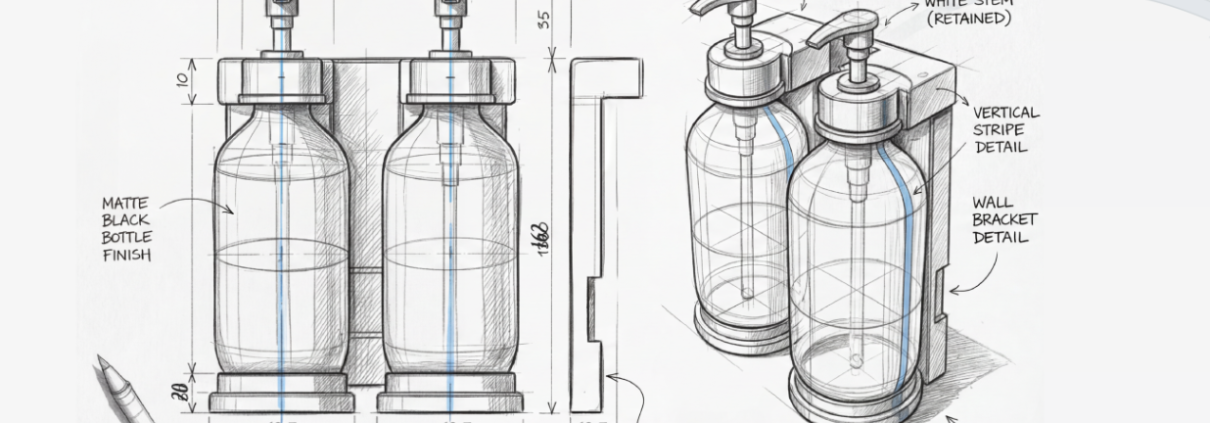
Design draft creation: Based on your requirements, designers create 2D renderings or 3D models to confirm appearance, color, logo placement, and other visual elements

3D modeling: Engineers build a digital 3D model to confirm dimensions, structure, and assembly relationships

Mockup making (if needed): Use 3D printing or CNC machining to create physical mockups (rapid prototypes) for appearance and assembly verification

Review and feedback: You evaluate the design drafts, 3D models, or mockups and provide revision suggestions

Final confirmation: All details are agreed upon, and the project moves to mold development

For simple projects requiring only logo customization or color changes, this phase takes approximately 3-7 business days. For complex projects requiring entirely new designs, it may take 10-15 business days.

Key confirmation points:

□ Is the appearance shape as expected?

□ Is the color accurate (reference to Pantone color code recommended)?

□ Is the logo position and size appropriate?

□ Do the dimensions meet installation and usage requirements?

Step 3: Mold Development and First Article Confirmation — From Digital to Physical

This step is the most critical in ODM customization and best demonstrates the manufacturer’s capabilities. The mold is the “mother” of product production, and its quality directly determines the final product’s quality.

Mold Development Process:

Mold design: Engineers design the mold structure based on the confirmed 3D model

Mold machining: CNC machining, EDM (electrical discharge machining), etc., to manufacture steel molds

Trial molding: Use the new mold for trial production of a small quantity to verify molding quality and dimensional accuracy

First article confirmation: Ship trial-molded products to the client for final approval

For plastic soap dispensers, the mold development cycle is typically 20-30 business days; for stainless steel dispensers, drawing molds typically take 15-25 business days. Sensor-operated electronic dispensers, which involve electronic component molds, may extend to 40-60 business days.

About mold costs:

If you select an existing product from the manufacturer’s library (ODM selection), there is no mold fee

For new mold development, the mold cost is typically borne by the client, but the mold belongs to the client

Some manufacturers refund the mold fee upon reaching a certain order volume

Leekong’s advantage: We have our own mold workshop and engineering team, enabling efficient mold development and flexible adjustments based on client needs. Compared to suppliers relying on external mold makers, we maintain better control over development timelines and quality.

Step 4: Mass Production — Quality is Made, Not Inspected

After first article approval, the project moves into mass production. This is the most time-consuming phase of the entire process and the critical stage for quality control.

Production Process Flow:

Raw Material Procurement → Injection Molding/Stamping/Casting → Surface Finishing → Assembly → Functional Testing → Packaging

Detailed Breakdown by Process:

Process Plastic Soap Dispensers Stainless Steel Dispensers Sensor-Operated Electronic Dispensers
Raw Materials ABS/PP plastic pellets 304 stainless steel sheets Plastic/metal + PCB
Forming Process Injection molding Drawing/stamping Injection molding + SMT assembly
Surface Finishing Painting/Plating/Silk-screen Brushing/Polishing/PVD Painting/Plating
Assembly Manual + semi-automated Manual assembly Assembly line + functional testing
Testing Appearance/Function sampling Appearance/Function sampling 100% functional testing


Quality Control System (QA & QC)

Rigorous quality control ensures product consistency. We have inspection checkpoints at every stage of production:

  • Incoming Quality Control (IQC):All raw materials are inspected before entering the warehouse to ensure plastic pellets, stainless steel sheets, electronic components, etc., meet specifications
  • In-Process Quality Control (IPQC): Sampling during production to detect anomalies early and prevent defective products from moving to the next stage
  • Final Quality Control (FQC):Functional testing and appearance inspection before packaging
  • Outgoing Quality Control (OQC):Final inspection before shipment to ensure each batch meets quality standards

Production Timeline Reference:

Standard products: 15-25 business days

Customized products (with logo, color): 25-35 business days

New mold development: 30-45 business days

Step 5: Quality Testing and Certification — Ensuring Global Compliance

Before products leave the factory, ensuring they meet target market regulations and certification requirements is crucial. This is a key distinction between professional manufacturers and ordinary factories.

Key Certifications:

Certification Target Market Applicable Product Types Requirement
FDA United States Products contacting skin/liquids Material safety, no harmful substance leaching
REACH European Union All products No Substances of Very High Concern (SVHC)
RoHS European Union Electronic products Restriction of lead, mercury, cadmium, etc.
LFGB Germany Food-contact products German food and commodities safety standards
ISO 9001 Global All products Quality management system certification

Leekong’s advantage: We provide products compliant with FDA, REACH, RoHS, and other international standards, and can provide corresponding certification documents upon request. For the PCBA design of sensor-operated dispensers, we also support full BOM/Gerber file delivery, ensuring clients have complete understanding and control of their products.

Step 6: Packaging and Shipment — The Final Mile of Perfect Delivery

After production is complete and quality inspection passed, products move to packaging and shipment. Packaging is not only a means of protecting products but also an important part of the brand experience.

Packaging Options:

Packaging Level Standard Solution Branded Custom Solution
Inner packaging Transparent poly bag Non-woven fabric bag, OPP bag with logo
Intermediate packaging Standard inner box Custom printed color box
Outer packaging 5-layer corrugated carton Custom printed outer carton

Shipping Methods and Transit Times:

Method Best For Transit Time
International Courier (DHL/FedEx/UPS) Samples, small batches 3-7 business days
Air Freight Medium batches, urgent orders 7-12 business days
Sea Freight Large volume orders 20-40 business days

Pre-shipment checklist:

□ Does the quantity match the order?

□ Is the packaging intact?

□ Are labels and markings correct?

□ Are customs documents complete (invoice, packing list, bill of lading, certificate of origin, etc.)?

Part 3: Leekong’s ODM Customization Advantages

3.1 Low MOQ — Let Brands Start Small

Minimum Order Quantity (MOQ) is a major barrier for new brands and small-to-medium clients entering the custom products market. Traditional manufacturers typically require MOQs of 3,000-5,000 units, which is prohibitive for many clients.

Leekong’s MOQ Strategy:

Customization Type Typical MOQ Best For
Laser engraving logo (existing product) 500 units Startup brands, crowdfunding projects
Color customization (existing mold) 1,000 units Boutique hotels, brand customization
New mold development 3,000-5,000 units Premium brands, exclusive product lines


For stainless steel products, our MOQ is even more flexible, starting as low as 100-500 units. This enables boutique hotels, independent brands, and startups to access high-quality custom products.

Real case: A skincare startup needed just 500 soap dispensers for a crowdfunding project. They chose our “semi-custom” solution—existing stainless steel bottle body with laser-engraved logo—easily meeting the MOQ. Their campaign exceeded its funding goal by 340%. Four months later, they reordered 5,000 units.

3.2 Fast Prototyping — Shortening Time-to-Market

In a fast-paced market, speed is competitive advantage. Leekong’s prototyping service ensures you can validate your product design quickly.

Customization Type Sample Lead Time
Logo customization / Color change 7-10 business days
Surface finish customization 10-25 business days
New mold development (mockup + mold) 20-40 business days

Standard prototyping takes approximately 2 weeks, significantly faster than the industry average.

3.3 Flexible Customization — Meeting Diverse Needs

Leekong offers comprehensive customization services from basic to advanced:

  • Logo customization:Silk-screen printing, UV transfer, laser engraving, metal badge inlay
  • Color customization: Pantone color matching, unlimited color options
  • Surface finishing:Brushed, polished, electroplated, PVD, spray coating
  • Packaging customization:Full design for inner boxes, outer cartons, instruction manuals, labels
  • Structural customization: New mold development, exclusive shapes, functional customization

3.4 Dual Production Capability — Expert in Both Plastic and Stainless Steel

We maintain complete dual production lines for both plastic injection molding and stainless steel processing, enabling flexible material selection based on your project requirements. Whether you need large-volume plastic products or small-batch premium stainless steel items, we have proven production experience.

Global clients we’ve served: Marriott, H World Group, Hunter, The Guest Supply — these internationally renowned brands’ trust in us confirms our commitment to quality.

Conclusion

From sketch to finished product, ODM soap dispenser customization is not a mysterious black box but a clear, navigable path. From needs communication to mold development, from sample confirmation to mass production, every step follows established processes and standards.

For brand owners, the greatest value of the ODM model is: turning ideas into marketable products with controllable cost and time. You don’t need to own a factory, understand injection molding processes, or even draw blueprints yourself—you just need a clear idea and a reliable partner.

Leekong is committed to providing high-quality ODM/OEM custom soap dispenser services to clients worldwide, with a complete industry chain from design, molding, production to quality inspection. Whether you want to private-label existing products from our library or develop entirely unique custom products, we offer professional one-stop solutions.

Ready to turn your idea into a product? Contact us, tell us your requirements, and we’ll provide an initial solution within 24 hours
Leekong Hotel bathroom soap dispenser manufacturer, accepts ODM&OEM and unique customization services

The Magnetic Stranglehold: How Trump’s 200% Tariff Threat on China Ripples All the Way to Your Hotel Bathroom

Introduction: An Invisible Dependency

We live in a world powered by the invisible. In the palm of your hand, in the car you drive, and in the very room you’re sitting in, countless devices hum with life thanks to a technological marvel most never think about: the permanent magnet. Not just any magnet, but high-performance rare-earth magnets, primarily made from an alloy called Neodymium (NdFeB).

These magnets are the silent, powerful hearts of the modern world. They turn the motors in electric vehicles, spin the turbines in wind generators, and drive the hard drives and speakers in our computers. Their strength, efficiency, and miniaturization are unparalleled. And as former President Donald Trump loudly proclaimed on the campaign trail, China holds a near-total monopoly on their production. His threat? A staggering 200% tariff on Chinese-made magnets unless the supply is secured on his terms—a move he claims is vital for national and economic security.

While the discourse focuses on EVs and missiles, the ripple effects of such a tectonic shift in trade policy would be felt far and wide, reaching deep into the seemingly unrelated corridors of the global hotel industry. How? The answer might surprise you the next time you check into a hotel and wave your hand under an automated soap dispenser.

Part 1: The Core of the Crisis – China’s Magnetic Monopoly

First, let’s dissect Trump’s claim. Is it just political hyperbole? Surprisingly, the facts largely back him up.

The Scale of Dominance: China controls over 90% of the global production of rare earth permanent magnets. This dominance isn’t accidental. It stems from a decades-long, state-supported strategy to control the entire value chain—from mining the raw rare earth minerals (where China also holds a commanding share) to the complex processes of refining, alloying, and magnet sintering.

Why It Matters: These magnets aren’t a commodity like steel or plastic. They are a critical enabler of high-tech and green technology. An electric vehicle uses several kilograms of them. A single modern wind turbine can use up to a ton. Without a stable, affordable supply, the ambitions of nations and corporations to transition to a green economy hit a monumental roadblock.

The Trump Doctrine: Tariffs as a Blunt Instrument: Trump’s proposed solution is classic Trumpian economics: use the sledgehammer of tariffs to smash the dependency. A 200% tariff is not designed to be a nuisance; it’s designed to be a kill switch.

The goal is twofold:

  1. Compel Immediate Concession: To strong-arm China into “supplying” magnets on terms more favorable to the U.S., potentially involving direct deals or forced technology transfers.
  2. Onshore Production: To make Chinese magnets so prohibitively expensive that U.S. manufacturers are forced to source elsewhere, thereby catalyzing a rebirth of the magnet and rare earth processing industry in America almost overnight.

The immediate analyses focused on the big-ticket items: the added cost to EVs, the impact on national defense contractors, and the potential for renewed inflation. But protectionism, like gravity, pulls everything downward. The cost increases trickle down through every layer of the manufacturing ecosystem, eventually landing in the most unexpected places.

Part 2: The Unlikely Connector: Magnets in the Modern Hotel Industry

Now, let’s step into the world of hospitality. The hotel industry is a master of ambiance, experience, and operational efficiency. In the relentless pursuit of these goals, technology has become deeply embedded, much of it relying on the very components caught in the crosshairs of a new trade war.

Consider the modern, upscale hotel bathroom. It’s a sanctuary designed for convenience and a touch of futuristic elegance. Gone are the messy, germ-ridden bar soaps and pump bottles. In their place is the sleek, hygienic, and touch-free sensor soap dispenser.

(Image: An infographic breaking down a sensor soap dispenser, highlighting the small but powerful neodymium magnet inside the motor that drives the pump.)

This ubiquitous device is a perfect case study. Inside every automated soap dispenser is a small electric motor that drives the pump. And inside that tiny motor, providing the precise and powerful force needed for its quick, reliable operation, is a neodymium magnet.

The hospitality industry buys these dispensers by the millions. They are in every guest room, every public restroom, in gyms, and in spas. For a large hotel chain like Marriott or Hilton, a standard renovation or new build project might involve ordering hundreds of thousands of units. Their reliability is non-negotiable; a malfunctioning dispenser leads to guest complaints, maintenance calls, and a perceived drop in quality.

Currently, these units are affordable. Manufacturers, primarily based in China or sourcing their components from there, can produce them at a cost that allows hotels to purchase them in bulk without a second thought. The entire supply chain is optimized around this Chinese dominance.

Part 3: The Ripple Effect: 200% Tariffs Check Into the Hotel

So, what happens when Trump’s 200% tariff is implemented?

Phase 1: The Direct Hit to Hardware Suppliers

The companies that manufacture sensor soap dispensers face an immediate and catastrophic cost increase. The core component driving the motor—the magnet—has suddenly seen its price multiply. A magnet that cost $1 now costs $3. This doesn’t just add $2 to the final product cost; it creates inflationary pressure on the entire manufacturing process. The cost of the motor assembly goes up, the cost of the final assembly goes up, and the overhead is spread across a now more expensive product.

Phase 2: The Hospitality Industry’s Soaring OPEX

The hotel industry is a business of razor-thin margins where operational expenditure (OPEX) is meticulously managed. The purchasing managers for major hotel chains now receive new quotes from their suppliers for automated soap dispensers. The price has potentially doubled.

They are faced with a brutal set of choices:

Choice A: Absorb the Cost: Eat the massive price increase, destroying their profitability on rooms and putting downward pressure on employee wages and other guest experience investments.

Choice B: Pass it On to the Guest: Increase room rates. In a competitive market, this is a dangerous game. The guest may not understand why a stay at a mid-tier hotel now costs 10% more, and they will simply book elsewhere.

Choice C: Degrade the Experience: Go backwards. Abandon the touch-free, hygienic standard and revert to cheap, wall-mounted plastic bottles or bar soaps. This is a devastating step back for an industry that sells itself on quality, cleanliness, and modern comfort. A guest’s perception of a hotel’s cleanliness is paramount, and a downgraded bathroom amenity sends a powerfully negative message.

Phase 4: The Innovation Freeze

Beyond immediate costs, innovation grinds to a halt. Hotel brands are constantly looking for the next amenity to differentiate themselves. Imagine smart mirrors with integrated displays, advanced climate control systems, or even in-room robotics—all concepts in development. Nearly all of them rely on high-efficiency motors and actuators powered by neodymium magnets. A trade war that makes these components unaffordable doesn’t just impact today’s soap dispensers; it postpones the next generation of hotel technology indefinitely.

Part 4: Beyond the Bathroom – A Hotel’s Silent Magnetic Dependency

The soap dispenser is just the tip of the iceberg. A hotel’s reliance on magnets is pervasive:

HVAC Systems: The compressors in modern, energy-efficient heating and cooling systems use magnetized motors.

Security Systems: Key card readers, electronic door locks, and alarm systems all contain critical magnetic components.

Kitchen and Laundry: The motors in industrial dishwashers, elevators, and laundry machinery are major consumers of magnetic technology.

Back of House: Computers, servers, and power backup systems all rely on this technology.

A 200% tariff on the core component of all this machinery doesn’t just affect capital expenditure (CAPEX) for new builds; it cripples the maintenance and replacement budget for existing properties. The cost of replacing a failed HVAC motor could become prohibitive.

Conclusion: The High Cost of Decoupling

Donald Trump’s threat of a 200% tariff on Chinese magnets is framed as a bold move to reclaim American economic sovereignty. The intended targets are clear: electric vehicles and defense. However, the law of unintended consequences dictates that the shrapnel from this economic policy will fly far and wide, embedding itself in the fabric of everyday business and life.

The hotel industry, a global sector that relies on predictability, cost control, and continuous innovation to provide a seamless guest experience, finds itself an unwitting casualty. The journey from a geopolitical tariff threat to a higher minibar bill or a less luxurious bathroom experience is shorter than it appears. It is a journey powered by a tiny, powerful magnet—a reminder of how interconnected and fragile our globalized supply chain truly is.

The path to a secure supply of critical materials is necessary, but it must be tread carefully. A sledgehammer approach might aim for China’s monopoly but end up smashing the sophisticated, cost-effective ecosystem that supports industries from clean energy to something as simple as ensuring a hotel guest can get a squirt of soap without touching a germ-laden pump. The true test of policy is not just in protecting national security, but in understanding and mitigating the cascading effects that eventually check in at every hotel door.

Hand hygiene is one of the most important measures to prevent transmission of infectious agents and plays a major role in prevention of infection in any type of healthcare setting. The intention of the present recommendation on soap and hand rub dispensers in healthcare facilities is to close this gap and to enhance future improvement of dispenser functionality and design. Regardless of manufacture and design of a hand rub or liquid soap dispensers the following requirements shall be met in healthcare facilities:


Triggering the dispenser must be possible without using hands. Sensor- or elbow-operated dispensers both fulfill this requirement. Dispensers must be only refillable in a modality where the content, be it a hand rub or liquid soap, cannot be contaminated. This is achieved best by using replaceable cartridge systems. Refilling through “top-up” must not be possible. The dispenser should allow usage of different types of cartridges made by different manufacturers. Dispensers must be operated and maintained such that a microbial contamination of the pump nozzle may easily be avoided. It must be possible to identify the products used in a dispenser easily and without any manipulation. Identifying the type of product, be it a hand rub or a liquid soap, as well as reading the product’s name and critical manufacturers’ warnings must be possible at any time. The dispenser must allow identification of the level of the used product without any further manipulation at any time. The design of the dispenser must allow easy cleaning and disinfection the outside and inside of the dispenser. The manufacturer of the dispenser must provide the user with information on applicable chemicals and cleaning products. It must be possible to reprocess the dispenser and all of its permanent parts by applying machine based thermal disinfection at an A0-value of minimum 60 (e.g., 80°C/1 minute). Automatically portioning dispensers shall not fail during 200 hubs. The maximal allowed failure rate shall not exceed 1% (2 out of 200 consecutive hubs). A dispenser used for alcohol-based hand rubs must allow keeping the alcohol concentration constant over a time period of 3 months. The maximum acceptable decrease in the concentration of the alcohol shall not exceed 5%. Liquid soap and hand rub dispensers with single-use pumps, ideally already mounted on the cartridge and to be discharged with the empty cartridge, are preferable. If pumps are used on the next consecutive cartridge, the manufacturer must provide the user with a detailed introduction for cleansing and reprocessing before further use. Because of forensic reasons it is recommended to place a good readable sign on the dispenser indicating e.g. “Apply alcohol based hand rubs only on the hand! Do not drink, avoid spraying into the eye or application on mucous membranes”. It is regarded as an additional benefit, if the dispenser is able to document the consumption of hand rub or the frequency of hubs either mechanically or electronically. Hand hygiene is one of the most important measures to prevent transmission of infectious agents and plays a major role in prevention of infection in any type of healthcare setting . Smart soap dispenser, also known as automatic soap dispenser, automatic dispenser, soap or machine, soap liquid device, is a used to automatically to soap to wash your hands, to avoid the secondary pollution of sanitary appliances.
China more than 13, one hundred million people of intelligence to the soap market far less than in the us and Europe countries, an American market intelligence to the dispenser product market scale is times larger than the Chinese market, investigate its reason, in addition to consumers is the decisive factor, the construction of market channels and consumer guide is extremely important.
Fortunately, reform and development for more than 30 years, not only created a large increase of material wealth, more on people’s consumption patterns has very important influence, to Chinese intelligence to the dispenser market huge growth opportunities.
A, intelligent to soap solution of key species can be divided into stainless steel stainless steel standard color light color intelligence to the dispenser, stainless steel wire drawing color intelligence to soap;
According to the function can be divided into a lock intelligence give soap dispenser and unlocked intelligence apparatus.
Second, the principle scheme of intelligent to soap 1. Microcomputer infrared liquid soap, the precision of integrated circuit technology, the rehydration interface of open mode, using intelligent infrared sensor, avoid contact with the hand, prevent cross infection. With 4 x 1.5 V dry cell, suitable for all kinds of soap and detergent.
2. The man held out his hand is open to the dispenser switch automatically receive signals, thus working out soap or foam.
Work with automatic setting time and random two work modes.
At present many supply dispenser adopts set timing soap or in the form of a bubble.
That is in your hand soap or bubble, to the dispenser received signal automatically, and let the machine work, but the machine’s work with the stipulated time, to the set time will automatically stop the operation of the machine.
Three, smart soap dispenser solution to the structure of intelligent device, generally includes a fixed set of produced liquid on mesa bib-cock, set up under the mesa soap bottle, used to soap hydraulic pressure out of the bottle of various institutions, used to drive the liquid fluid pressure button, etc.

Finally, in the use of hand sanitizer, a lot of people have a myth – the more liquid soap, wash clean.
In fact, such a deep clean can damage the skin and make the skin keep moisture not only, also is easier to let the bacteria invasion.
But ordinary pressure liquid soap bottles and difficult to grasp, press out the amount of soap is widely, try Morton induction foam liquid soap, can adjust the quantity of liquid, handy.
Out of the bubble is obvious to pore density, clean and more in-depth, wash more easily, can match various brands of bubble type hand sanitizer.
At the same time, it has three files out of the bubble volume is adjustable, can meet the adults, children, kitchen, toilet USES is pretty good.

Portfolio Items