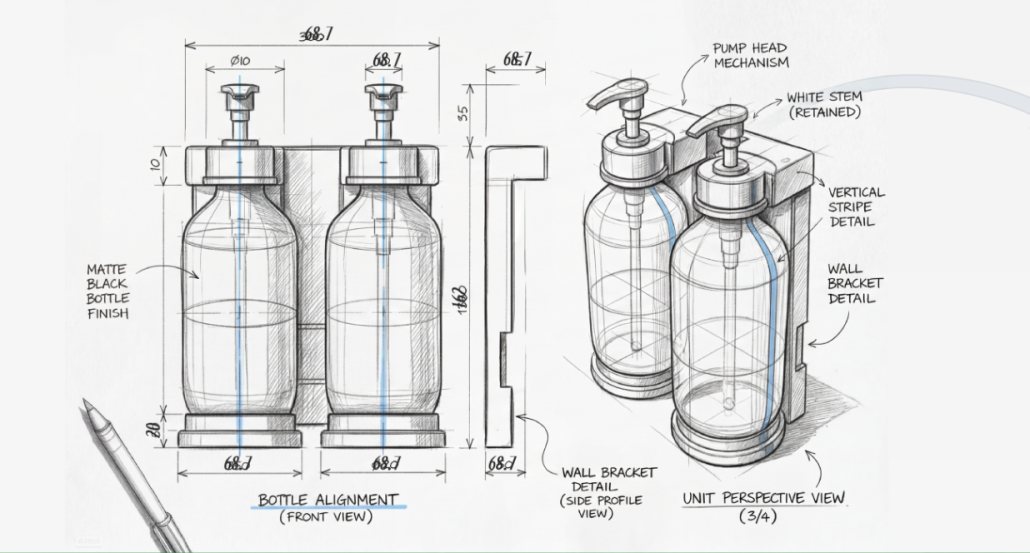
From Sketch to Finished Product: A Complete Guide to the ODM Soap Dispenser Customization Process
—How Your Idea Becomes a Product on the Shelf
Introduction
“I have an idea for a soap dispenser, but I don’t know where to start.”
This is the first thing many brand owners, hotel procurement managers, and entrepreneurs say when they contact us. They may already have a clear concept—a certain material, a specific color, a unique shape, or even just a sketch on a napkin. But they’re uncertain: Can this idea become a real product? How much will it cost? How long will it take?
The answer is: Yes, and it’s simpler than you might think.
The emergence of ODM (Original Design Manufacturing) has completely transformed the barriers to product development. You no longer need to own your own factory, molds, or engineering team. You just need an idea, and a professional manufacturer can turn that idea into 3D drawings, into samples, and ultimately into thousands of finished products on store shelves.
This article will break down the complete ODM soap dispenser customization process—from initial needs communication to final mass production and delivery. Whether you’re a brand newcomer experiencing custom products for the first time or an experienced procurement professional looking to optimize your supply chain, this guide will provide you with a clear roadmap.
Part 1: What is ODM? Why Choose ODM?
1.1 ODM vs OEM: Understanding the Difference
Before diving into the process, it’s essential to clarify two often-confused concepts:
| Dimension | ODM (Original Design Manufacturing) | OEM (Original Equipment Manufacturing) |
| Design Source | Manufacturer provides existing designs; client selects and customizes | Client provides complete design; factory produces to spec |
| Mold Ownership | Usually owned by manufacturer (can be shared) | Owned exclusively by client |
| Development Cycle | Shorter (selection + minor customization) | Longer (development from scratch) |
| MOQ Requirement | Lower | Higher (need to amortize mold costs) |
| Cost Structure | Design amortization included in unit price | Separate mold development fee required |
| Best For | Brands wanting fast product launch without high mold investment | Brands with unique designs seeking maximum differentiation |
For most clients trying customization for the first time, ODM is the more practical choice. You can select a base model from the manufacturer’s existing product library, then customize color, logo, packaging, and some details. This approach achieves brand differentiation while avoiding the high costs and long timelines of developing from scratch.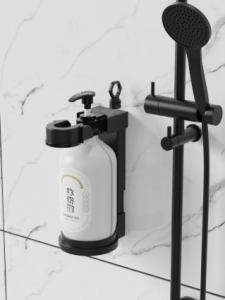
1.2 Why Choose ODM?
The core advantages of the ODM model are low barriers, high efficiency, and low risk:
- No need to build your own factory: You don’t need to invest in facilities, equipment, or labor
- No need to develop your own molds: Leverage the manufacturer’s existing molds, saving hundreds of thousands in mold investment
- Professional team support: The manufacturer’s design, engineering, and quality control teams serve you
- Fast time-to-market:From concept to finished product, the cycle is much shorter than building your own production line
Part 2: The ODM Soap Dispenser Customization Process — 5 Key Steps
A typical ODM soap dispenser customization project, from initial idea to final delivery, generally includes the following 5 stages. The entire cycle typically takes 30-60 business days, depending on the complexity of customization and order quantity.
Step 1: Needs Communication — Laying the Foundation for Customization
This is the most important step in the entire process. Clear communication can prevent 80% of potential problems down the line. A successful ODM project starts with a thorough understanding of the client’s needs.
In this phase, you should provide the manufacturer with the following information:
Product type: Manual or sensor-operated? Plastic or stainless steel? Countertop or wall-mounted?
Capacity requirement: 300ml, 500ml, 800ml, or 1000ml+?
Material selection: ABS plastic, 304 stainless steel, or other materials?
Color/finish: Matte black, brushed gold, chrome, gunmetal, or white?
Branding: Is logo printing required? Logo position and size? Laser engraving?
Packaging requirements: Standard carton or custom color box?
Target price: Your expected unit price range
Estimated quantity: Initial order quantity and annual purchase forecast
The manufacturer’s role:
Recommend suitable base models based on your needs
Assess feasibility (some colors or finishes may require additional processes)
Provide initial quotations and timeline estimates
Practical advice:
If you have reference images or competitor product photos, be sure to share them—a good picture is worth a thousand words
Be clear about your target market (Europe/US/Middle East/Southeast Asia, etc.), as different markets have different certification requirements
If this is your first collaboration, start with simple customization (like logo-only or packaging changes) to reduce risk
Step 2: 3D Prototyping and Confirmation — Making the Idea “Visible”
Once needs communication is complete, the manufacturer’s design team begins work. The core goal of this step is: before mold development, let you “see” the final product’s appearance and structure.
Prototyping Process:
Design draft creation: Based on your requirements, designers create 2D renderings or 3D models to confirm appearance, color, logo placement, and other visual elements
3D modeling: Engineers build a digital 3D model to confirm dimensions, structure, and assembly relationships
Mockup making (if needed): Use 3D printing or CNC machining to create physical mockups (rapid prototypes) for appearance and assembly verification
Review and feedback: You evaluate the design drafts, 3D models, or mockups and provide revision suggestions
Final confirmation: All details are agreed upon, and the project moves to mold development
For simple projects requiring only logo customization or color changes, this phase takes approximately 3-7 business days. For complex projects requiring entirely new designs, it may take 10-15 business days.
Key confirmation points:
□ Is the appearance shape as expected?
□ Is the color accurate (reference to Pantone color code recommended)?
□ Is the logo position and size appropriate?
□ Do the dimensions meet installation and usage requirements?
Step 3: Mold Development and First Article Confirmation — From Digital to Physical
This step is the most critical in ODM customization and best demonstrates the manufacturer’s capabilities. The mold is the “mother” of product production, and its quality directly determines the final product’s quality.
Mold Development Process:
Mold design: Engineers design the mold structure based on the confirmed 3D model
Mold machining: CNC machining, EDM (electrical discharge machining), etc., to manufacture steel molds
Trial molding: Use the new mold for trial production of a small quantity to verify molding quality and dimensional accuracy
First article confirmation: Ship trial-molded products to the client for final approval
For plastic soap dispensers, the mold development cycle is typically 20-30 business days; for stainless steel dispensers, drawing molds typically take 15-25 business days. Sensor-operated electronic dispensers, which involve electronic component molds, may extend to 40-60 business days.
About mold costs:
If you select an existing product from the manufacturer’s library (ODM selection), there is no mold fee
For new mold development, the mold cost is typically borne by the client, but the mold belongs to the client
Some manufacturers refund the mold fee upon reaching a certain order volume
Leekong’s advantage: We have our own mold workshop and engineering team, enabling efficient mold development and flexible adjustments based on client needs. Compared to suppliers relying on external mold makers, we maintain better control over development timelines and quality.
Step 4: Mass Production — Quality is Made, Not Inspected
After first article approval, the project moves into mass production. This is the most time-consuming phase of the entire process and the critical stage for quality control.
Production Process Flow:
Raw Material Procurement → Injection Molding/Stamping/Casting → Surface Finishing → Assembly → Functional Testing → Packaging
Detailed Breakdown by Process:
| Process | Plastic Soap Dispensers | Stainless Steel Dispensers | Sensor-Operated Electronic Dispensers |
| Raw Materials | ABS/PP plastic pellets | 304 stainless steel sheets | Plastic/metal + PCB |
| Forming Process | Injection molding | Drawing/stamping | Injection molding + SMT assembly |
| Surface Finishing | Painting/Plating/Silk-screen | Brushing/Polishing/PVD | Painting/Plating |
| Assembly | Manual + semi-automated | Manual assembly | Assembly line + functional testing |
| Testing | Appearance/Function sampling | Appearance/Function sampling | 100% functional testing
|
Quality Control System (QA & QC)
Rigorous quality control ensures product consistency. We have inspection checkpoints at every stage of production:
- Incoming Quality Control (IQC):All raw materials are inspected before entering the warehouse to ensure plastic pellets, stainless steel sheets, electronic components, etc., meet specifications
- In-Process Quality Control (IPQC): Sampling during production to detect anomalies early and prevent defective products from moving to the next stage
- Final Quality Control (FQC):Functional testing and appearance inspection before packaging
- Outgoing Quality Control (OQC):Final inspection before shipment to ensure each batch meets quality standards
Production Timeline Reference:
Standard products: 15-25 business days
Customized products (with logo, color): 25-35 business days
New mold development: 30-45 business days
Step 5: Quality Testing and Certification — Ensuring Global Compliance
Before products leave the factory, ensuring they meet target market regulations and certification requirements is crucial. This is a key distinction between professional manufacturers and ordinary factories.
Key Certifications:
| Certification | Target Market | Applicable Product Types | Requirement |
| FDA | United States | Products contacting skin/liquids | Material safety, no harmful substance leaching |
| REACH | European Union | All products | No Substances of Very High Concern (SVHC) |
| RoHS | European Union | Electronic products | Restriction of lead, mercury, cadmium, etc. |
| LFGB | Germany | Food-contact products | German food and commodities safety standards |
| ISO 9001 | Global | All products | Quality management system certification |
Leekong’s advantage: We provide products compliant with FDA, REACH, RoHS, and other international standards, and can provide corresponding certification documents upon request. For the PCBA design of sensor-operated dispensers, we also support full BOM/Gerber file delivery, ensuring clients have complete understanding and control of their products.
Step 6: Packaging and Shipment — The Final Mile of Perfect Delivery
After production is complete and quality inspection passed, products move to packaging and shipment. Packaging is not only a means of protecting products but also an important part of the brand experience.
Packaging Options:
| Packaging Level | Standard Solution | Branded Custom Solution |
| Inner packaging | Transparent poly bag | Non-woven fabric bag, OPP bag with logo |
| Intermediate packaging | Standard inner box | Custom printed color box |
| Outer packaging | 5-layer corrugated carton | Custom printed outer carton |
Shipping Methods and Transit Times:
| Method | Best For | Transit Time |
| International Courier (DHL/FedEx/UPS) | Samples, small batches | 3-7 business days |
| Air Freight | Medium batches, urgent orders | 7-12 business days |
| Sea Freight | Large volume orders | 20-40 business days |
Pre-shipment checklist:
□ Does the quantity match the order?
□ Is the packaging intact?
□ Are labels and markings correct?
□ Are customs documents complete (invoice, packing list, bill of lading, certificate of origin, etc.)?
Part 3: Leekong’s ODM Customization Advantages
3.1 Low MOQ — Let Brands Start Small
Minimum Order Quantity (MOQ) is a major barrier for new brands and small-to-medium clients entering the custom products market. Traditional manufacturers typically require MOQs of 3,000-5,000 units, which is prohibitive for many clients.
Leekong’s MOQ Strategy:
| Customization Type | Typical MOQ | Best For |
| Laser engraving logo (existing product) | 500 units | Startup brands, crowdfunding projects |
| Color customization (existing mold) | 1,000 units | Boutique hotels, brand customization |
| New mold development | 3,000-5,000 units | Premium brands, exclusive product lines |
For stainless steel products, our MOQ is even more flexible, starting as low as 100-500 units. This enables boutique hotels, independent brands, and startups to access high-quality custom products.
Real case: A skincare startup needed just 500 soap dispensers for a crowdfunding project. They chose our “semi-custom” solution—existing stainless steel bottle body with laser-engraved logo—easily meeting the MOQ. Their campaign exceeded its funding goal by 340%. Four months later, they reordered 5,000 units.
3.2 Fast Prototyping — Shortening Time-to-Market
In a fast-paced market, speed is competitive advantage. Leekong’s prototyping service ensures you can validate your product design quickly.
| Customization Type | Sample Lead Time |
| Logo customization / Color change | 7-10 business days |
| Surface finish customization | 10-25 business days |
| New mold development (mockup + mold) | 20-40 business days |
Standard prototyping takes approximately 2 weeks, significantly faster than the industry average.
3.3 Flexible Customization — Meeting Diverse Needs
Leekong offers comprehensive customization services from basic to advanced:
- Logo customization:Silk-screen printing, UV transfer, laser engraving, metal badge inlay
- Color customization: Pantone color matching, unlimited color options
- Surface finishing:Brushed, polished, electroplated, PVD, spray coating
- Packaging customization:Full design for inner boxes, outer cartons, instruction manuals, labels
- Structural customization: New mold development, exclusive shapes, functional customization
3.4 Dual Production Capability — Expert in Both Plastic and Stainless Steel
We maintain complete dual production lines for both plastic injection molding and stainless steel processing, enabling flexible material selection based on your project requirements. Whether you need large-volume plastic products or small-batch premium stainless steel items, we have proven production experience.
Global clients we’ve served: Marriott, H World Group, Hunter, The Guest Supply — these internationally renowned brands’ trust in us confirms our commitment to quality.
Conclusion
From sketch to finished product, ODM soap dispenser customization is not a mysterious black box but a clear, navigable path. From needs communication to mold development, from sample confirmation to mass production, every step follows established processes and standards.
For brand owners, the greatest value of the ODM model is: turning ideas into marketable products with controllable cost and time. You don’t need to own a factory, understand injection molding processes, or even draw blueprints yourself—you just need a clear idea and a reliable partner.
Leekong is committed to providing high-quality ODM/OEM custom soap dispenser services to clients worldwide, with a complete industry chain from design, molding, production to quality inspection. Whether you want to private-label existing products from our library or develop entirely unique custom products, we offer professional one-stop solutions.
Ready to turn your idea into a product? Contact us, tell us your requirements, and we’ll provide an initial solution within 24 hours