Posts

2026 Hotel Amenities Surge: Procurement Strategies

—A Strategic Pivot for Hotel Procurement

Introduction

The hotel industry faced its first major shock of 2026. It stemmed from raw material markets, not demand softness or staffing shortages. Costs for hotel guest amenities have been climbing relentlessly. Factory-gate prices now change almost daily, with morning quotes often invalid by afternoon. Logistics costs are rising in parallel, and many hotel supply intermediaries are feeling the squeeze. The impact has not yet fully reached front-line hotel operations. However, sustained cost pressures will directly translate into higher procurement bills. For properties, this change is imminent.

Hotel procurement teams now stand at a crossroads. Do they continue with traditional consumable-based purchasing models, absorbing one price shock after another? Or do they rethink their procurement strategy from the ground up? This article analyzes the drivers behind the cost surge. It presents a viable path for hoteliers to regain control of their supply chains.
Part 1: The Two Main Drivers—Cotton Yarn and Petroleum

1.1 Cotton Yarn: Up Nearly 20% in Two Months

The core raw material for hotel towels, bath mats, and bed linens is cotton yarn. Prices for 32s and 40s pure cotton yarn were about USD 3400 per ton before the Spring Festival. These yarns typically account for more than 70% of linen product costs. By late March, they had surged past USD$4,000, a nearly 20% increase in just two months.

What makes the situation even more challenging is the sheer unpredictability. One linen manufacturer complained that fixed quotes. When a customer calls for a price, they must first check with the yarn supplier. By the time they call back, the price has often changed. Some distributors have received adjustment notices from upstream mills. They state: Effective immediately, all products are subject to same-day pricing. Quoted prices are valid only on the day of inquiry. A veteran distributor with over a decade of experience remarked, “In the past, price increases were like boiling a frog slowly.We feel boiling water pouring over us now.

The root cause lies in structural supply constraints. Structural supply constraints reduced Xinjiang’s cotton planting area by 5 to 7 million mu (330,000–470,000 hectares), a decline over 10%. Farmers are switching to wheat, and the resulting drop in expected cotton output has naturally driven prices higher.

1.2 Petroleum: PP Prices Jump USD$300/Ton in a Single Day

If you think switching to a polyester-cotton blend will save costs, think again—polyester is also derived from petroleum, and oil prices are rising too.

The upstream source for plastic resins is crude oil. Toothbrush handles, combs, slipper soles, shower gel bottles—these everyday hotel consumables all come from the petrochemical value chain: crude oil → naphtha → ole-fins → plastic resins, with each link adding cost. In late February, some institutions foretasted oil prices hitting $100 a barrel, triggering widespread market panic.

On March 9, PP resin (used for toothbrush handles) jumped USD$300 per ton in a single day—whereas a weekly increase of USD$30 had previously been considered substantial. PET resin (used for shower gel bottles) surged USD$243 per ton in one day, and by the end of March had accumulated a 34.8% increase month-over-month. Pure benzene spiked USD$385 per ton in a single session. According to the H1 2026 interim report of listed company Jiangnan Gaofiber, the average purchase price of polypropylene (PP) in the first half reached USD$1264.35 per ton, up 24.65% year-on-year.

In Hangji, Yangzhou—China’s largest production base for hotel daily necessities—upstream petrochemical plants began to “suspend offers” or ration sales from early March. Where a buyer could previously order 100 tons and receive 100 tons, now an order of 100 tons might only yield 20 tons, forcing them to source the rest elsewhere—only to find that other suppliers are also rationing.

Part 2: The Hotel Industry’s Dilemma—Costs Are Rising, But Room Rates Cannot Follow Suit

The impact of the raw material surge is hitting every category:

Linens: Towels, bath mats, and bed sheets are directly affected, with pure cotton yarn rising nearly 20% in two months.

Plastic-based amenities: Toothbrushes, combs, slippers, shower gel bottles, shampoo bottles—virtually all guest consumables are seeing price hikes. PP prices averaged 24.65% higher in the first half of 2026.

Sensor-operated equipment: Soap dispensers, automatic paper towel dispensers, and other electronic amenities are also under pressure due to rising costs of electronic components and plastic housings.

The fundamental contradiction, however, is this: costs are up, but room rates cannot easily follow suit. Economy hotels risk losing price-sensitive guests if they raise rates, and independent properties have little bargaining power. Profit margins are being compressed on all sides. Industry analysts suggest that 2026 could trigger a wave of consolidation in the hospitality sector.

Part 3: The Path Forward—Shifting from a “Consumables” Mentality to a “Durables” Mentality

In the face of this price surge, hotel procurement must re-examine a fundamental question: What are you actually buying—single-use consumables, or long-lasting assets?

3.1 Long-Term Cost Efficiency

A bottle of shower gel or a toothbrush is gone after one use—you have to buy it again next time. But a stainless steel soap dispenser or paper towel dispenser can last 5, 8, or even 10 years. When PP resin has risen 25% in six months, the cost of single-use plastic bottles climbs with it—while the cost of a durable stainless steel dispenser was locked in at the time of purchase. Over the long term, the per-use cost of durable dispensers is far lower than that of disposable consumables.

3.2 Environmental Compliance and Brand Value

The EU’s single-use plastics ban and China’s Green Hotel standards are accelerating the transition. Refillable soap dispensers can reduce plastic usage by an average of 56–77% compared to disposable mini-bottles. A growing number of hotel groups are placing ESG at the core of their strategy. Switching to fixed dispensers is not only a compliance measure but also a brand-boosting move that resonates with increasingly eco-conscious guests.

3.3 Supply Chain Stability, Avoiding Price Volatility

When upstream raw materials fluctuate wildly—quotations changing daily, if not hourly—relying on a “buy-today, use-today” consumables model means continuous exposure to price volatility. In contrast, durable dispensers involve a one-time procurement decision. You place your order, lock in the price, and you are no longer affected by whether PP resin spikes another USD$155 tomorrow.

3.4 Operational Efficiency Gains

Large-capacity refillable dispensers significantly reduce refill frequency, easing the burden on housekeeping staff. Transparent view windows allow staff to check liquid levels at a glance, eliminating unnecessary “open and check” steps and preventing the guest complaints that occur when dispensers run dry.

Conclusion

The 2026 hotel amenities price surge may appear to be a cost crisis on the surface, but at a deeper level, it is a catalyst for industry transformation. Moving from “buying consumables” to “investing in durable assets,” and from “passively absorbing price hikes” to “actively controlling costs,” is not just about short-term profits—it is about long-term competitiveness.

Leekong is committed to providing hotels with high-quality custom solutions in stainless steel and plastic soap dispensers, as well as paper towel dispensers. We help hotels replace single-use consumables with durable assets, building a procurement moat that withstands cost volatility.

Is your hotel ready for the current cost surge? Contact us to learn how durable dispensers can help you achieve long-term cost optimization.
2026 Summer Travel: Value-Driven Shifts

—How the Hotel Industry Can Win in the New Era of “Value-Driven” Competition

Introduction

Nevertheless, the 2026 summer travel market presents a seemingly contradictory yet profoundly significant picture. On one hand, despite persistent inflation, rising living costs, and ongoing geopolitical uncertainties, U.S. summer travel demand remains remarkably resilient. Travelers are not canceling their vacations; instead, they are rethinking how they spend their money. On the other hand, travelers’ spending behavior and decision-making logic have undergone fundamental changes. Nevertheless, they aren’t cutting back on vacations. However, they are completely changing how they choose where to stay and how much to allocate to each trip.

ODM Soap Dispenser Customization: A Complete Guide

Additionally, 49% of Americans plan a leisure trip in three months, showing ongoing holiday travel interest amid the economy. However, compared to earlier this year, travelers are reducing their overall trip frequency and moderating their travel budgets. Consequently, many travelers are consolidating trips into one or two longer, better-planned vacations. As a result, travelers are shifting away from three or four short trips.

Consequently, this shift signals the hospitality sector has entered a new era defined by quality over quantity, experience over price. The era of “build it and they will come” is over. Today, hotels must actively earn every booking by demonstrating clear, tangible value to increasingly discerning guests.

Based on the latest travel consumer research from Hospitality Net, sift, and Allah, we’ve summarized four defining traveler trends that will shape hotel performance this summer season. For hotel procurement decision-makers, brand operators, and suppliers to the hospitality industry — including companies like Leekong that provide custom soap dispensers and paper dispensers — understanding these trends is not just a matter of market intelligence. It is a strategic necessity for adjusting product configuration, optimizing supplier selection, and staying ahead of the competition.

Trend 1: AI-Powered Travel Planning Makes Guests More Rational and Comparison-Driven

Artificial intelligence has evolved from a novelty tool to a mainstream travel-planning instrument, fundamentally reshaping consumer booking behavior. In 2026, 52% of active leisure travelers use artificial intelligence to plan their trips — a 10% year-over-year increase — with ChatGPT and Gemini dominating the traveler toolkit.

What does this mean in practice? A traveler can now ask an AI assistant to “find me a hotel in Chicago with a pool, free breakfast, and guest ratings above 8.5, within a 10-minute walk of the Art Institute, for under $300 per night” — and receive a curated list of options within seconds. The AI can cross-reference reviews, compare pricing across platforms, analyze seasonal rate trends, and even suggest room upgrades based on past travel patterns.

This capability fundamentally changes the balance of power in the booking process. Travelers now enter the decision-making journey with more information, more clarity, and higher expectations than ever before. They are less susceptible to marketing hype and more responsive to verifiable quality indicators. With AI’s ability to compare destinations, hotel value, reviews, and travel experiences in seconds, guests evaluate every option with extreme precision. This means homogeneous hotels — those offering the same amenities as their competitors without any distinguishing features — are far easier to eliminate during customer decision-making.

For hoteliers, the message is clear: mediocrity is no longer an option. Every aspect of the guest experience must be thoughtfully designed and consistently delivered. This includes the often-overlooked details, such as bathroom amenities. A cheap, unreliable soap dispenser that drips or fails to dispense properly is precisely the kind of negative detail that AI-curated reviews will surface and amplify.

Implications for the Hotel Supplies Industry:

Travelers are more “educated” and demand higher quality and attention to detail in every aspect of hotel facilities

Poor-quality or outdated soap dispensers and paper dispensers in restrooms may become triggers for negative reviews — and in the age of AI, those reviews are more visible than ever

High-quality, design-conscious custom bathroom products are becoming a competitive differentiation for hotels on OTA and AI-powered booking platforms

Moreover, hotels investing in premium supplies signal to guests they care about every detail, building trust and loyalty.

Trend 2: Traditional Destination Traffic Dividends Fade; Unique Local Experiences Become the New Core Attraction

Popular conventional travel destinations are losing visitor attention — proof that simple city branding and standardized sightseeing resources are no longer enough to capture modern travelers. Cities that once relied on their global reputation are finding that reputation alone no longer drives bookings. Today’s guests actively seek diverse, niche, and destination-specific experiences that they cannot find anywhere else.

Moreover, local farm-to-table dining, handmade cultural workshops, seasonal exclusive outdoor activities, and community-based cultural festivals have become key booking drivers. Travelers want to eat what locals eat, learn skills from local artisans, and participate in traditions that are authentic to the place they are visiting. They want stories to tell, not just photos to post.

Hotels that rely only on basic room facilities without local characteristic offerings are gradually losing competitiveness in the saturated peak-season market. A hotel room is no longer just a place to sleep — it is a base for exploration, a portal to the destination experience. Guests expect hotels to curate local experiences, provide insider recommendations, and serve as authentic ambassadors for their location.

This trend is particularly pronounced among younger travelers. Indeed, Millennials and Gen Z travelers are driving the demand for “authenticity” in travel. Moreover, they prefer independent, design-led properties that reflect their surroundings over chain hotels. Boutique hotels, lifestyle brands, and econ-lodges are thriving as a result.

Implications for the Hotel Supplies Industry:

Hotels’ thematic and localization transformations are driving demand for customized, design-forward bathroom products that reflect local aesthetics and brand identity

More boutique hotels are choosing custom colors and exclusive finishes for soap dispensers to match their unique spatial design language — a seaside resort might choose ocean-blue ceramic finishes, while a mountain lodge might opt for matte black with wood accents

Suppliers like Leekong, with low-MOO customization services, are built precisely for these differentiation needs. The ability to deliver custom branded soap dispensers with relatively small order quantities enables boutique hotels to achieve premium differentiation without committing to massive inventory

Trend 3: Travel Value Is Redefined — Event-Driven Experiences Beat Low-Price Incentives

Price is no longer the primary factor influencing travel choices. This is a significant departure from previous years, when discounts and promotions often drove booking decisions. In 2026, 55% of travelers prioritize trips tied to special events, festivals, or cultural celebrations. Approximately 29% of visitors are willing to travel for landmark cultural and commemorative events, while 27% plan to attend sports games during their vacation.

What does this mean in practice? Instead of asking where the cheapest destination is, travelers now ask what events they want to join. A Taylor Swift concert, a Formula 1 race, a food and wine festival, or a total solar eclipse can drive bookings far more effectively than a 20% off room rate. Event-linked, immersive, one-of-a-kind experiences have become the most powerful differentiation for hotels and destinations to stand out during peak summer travel.

This trend also reflects a broader shift in consumer values. After years of uncertainty and disruption, travelers are placing higher value on meaningful experiences that create lasting memories. They are willing to pay more for experiences that feel special, unique, and worth talking about.

As a result, for hotels, this means being more intentional about event partnerships and programming. Hotels that align their offerings with local events — whether by creating event-specific packages, hosting pre- or post-event gatherings, or providing convenient transportation to venues — capture a larger share of this motivated travel segment.

Implications for the Hotel Supplies Industry:

During event periods, hotel occupancy surges, imposing higher demands on the durability and reliability of all hotel equipment and supplies

During major events, restroom usage frequency spikes dramatically, making stainless steel soap dispensers and high-capacity paper dispensers essential for maintaining hygiene standards and guest satisfaction

Hotels can extend their “event themes” through brand colors or exclusive branding on custom bathroom products, reinforcing the event atmosphere and creating memorable guest touchpoints

Event-driven hotels often need to scale up quickly and cost-effectively — suppliers offering low-MOO customization and fast turnaround times become valuable partners

Trend 4: Travelers Demand Dual Advantages — Digital Efficiency + Quiet, Private Luxury Stays

Modern guests expect seamless digital convenience as a basic standard, not as a premium upgrade. Mobile self-check-in, pre-arrival personalized room setup, customized travel itineraries, and keyless room entry are no longer differentiators — they are expectations. Guests want technology to work quietly in the background, eliminating friction without introducing complexity. They want to bypass front-desk queues, choose their own rooms, and control their room environment through their smartphones.

At the same time, the “quiet luxury” travel trend continues to grow in popularity. Quiet luxury is about understated elegance — premium materials, thoughtful design, and impeccable service without ostentation. It is the opposite of flashy, Instagram-first design. It is the feeling of being well cared for without being overwhelmed.

Solo travelers, multi-generational families, and wellness-focused guests increasingly favor low-density zones, quiet floors, spa-like bathrooms, and private relaxation areas where they can escape the crowds and recharge. These guests value peace, privacy, and personal space above all else. They are willing to pay a premium for hotels that respect their need for quietude.

The perfect combination of efficient digital services and warm, human-centric private experiences effectively improves guest satisfaction without requiring heavy hardware investment. It is not about choosing between technology and humanity — it is about using technology to enhance human interactions. When guests can handle routine tasks through digital channels, staff are freed to focus on meaningful, personalized service.

Implications for the Hotel Supplies Industry:

The “quiet luxury” concept extends to bathrooms — demand is growing for stainless steel soap dispensers with premium finishes like matte black, brushed gold, gunmetal, and rose gold that convey sophistication without boldness

Sensor-operated, low-noise soap dispensers and paper dispensers align perfectly with the “quiet luxury” experience. They provide touchless hygiene without the mechanical noise that can disturb peaceful environments

High-quality bathroom accessories become detailed proof of a hotel’s “quiet luxury” brand positioning. A well-designed, reliable soap dispenser communicates that the hotel cares about the small things — and if they care about the small things, guests trust they care about the big things too

Hotels catering to the quiet luxury segment are more likely to choose premium materials like 304 stainless steel over plastic, and custom finishes over standard stock designs

Conclusion: The New Rules of Competition for the Hotel Industry

The biggest challenge facing today’s hotel industry is no longer stimulating travel demand — demand is already there. The challenge is winning the intense competition for highly selective travelers who have more information, more choices, and higher expectations than ever before.

As consumer travel expectations continue to upgrade, pure price discounts can no longer drive bookings or build loyalty. The era of competing solely on price is over. Travelers are no longer seeking the cheapest option. Instead, they seek the best value for their money. They define value in increasingly sophisticated ways.

The key to future hotel competition lies in personalized service, authentic local immersion, and tangible guest value. Properties escape the trap of low-price competition and build systematic differentiated experiences. They will capture higher occupancy, better reviews, and sustainable premium revenue that extends beyond the summer peak season.

Hotel supplies suppliers face a clear and urgent direction. They must help hotel clients differentiate themselves in every detail, from restroom soap dispensers to public-area paper dispensers. Guests notice and critique every detail. The quality and design of bathroom products reflect a hotel’s brand. They are no longer a minor afterthought. It is a visible, tangible expression of a hotel’s brand values and quality standards.

Leekong is uniquely positioned to support this shift. Leekong is uniquely positioned to support this shift. We provide dual production in stainless steel and plastic dispensers. This enables hotels to differentiate themselves with premium, custom-designed bathroom products through flexible customization and low MOQs. Our partnerships with Marriott, H World Group, Hunter, and The Guest Supply reflect our commitment to quality and our ability to meet the needs of discerning hospitality clients.


Is your hotel ready for the 2026 summer travel wave? Contact Leekong today to learn how custom bathroom products can enhance your brand’s competitive differentiation and win the loyalty of today’s discerning travelers.

From Sketch to Finished Product: A Complete Guide to the ODM Soap Dispenser Customization Process

—How Your Idea Becomes a Product on the Shelf

Introduction

“I have an idea for a soap dispenser, but I don’t know where to start.”

This is the first thing many brand owners, hotel procurement managers, and entrepreneurs say when they contact us. They may already have a clear concept—a certain material, a specific color, a unique shape, or even just a sketch on a napkin. But they’re uncertain: Can this idea become a real product? How much will it cost? How long will it take?

The answer is: Yes, and it’s simpler than you might think.

The emergence of ODM (Original Design Manufacturing) has completely transformed the barriers to product development. You no longer need to own your own factory, molds, or engineering team. You just need an idea, and a professional manufacturer can turn that idea into 3D drawings, into samples, and ultimately into thousands of finished products on store shelves.

This article will break down the complete ODM soap dispenser customization process—from initial needs communication to final mass production and delivery. Whether you’re a brand newcomer experiencing custom products for the first time or an experienced procurement professional looking to optimize your supply chain, this guide will provide you with a clear roadmap.

Part 1: What is ODM? Why Choose ODM?

1.1 ODM vs OEM: Understanding the Difference

Before diving into the process, it’s essential to clarify two often-confused concepts:

Dimension ODM (Original Design Manufacturing) OEM (Original Equipment Manufacturing)
Design Source Manufacturer provides existing designs; client selects and customizes Client provides complete design; factory produces to spec
Mold Ownership Usually owned by manufacturer (can be shared) Owned exclusively by client
Development Cycle Shorter (selection + minor customization) Longer (development from scratch)
MOQ Requirement Lower Higher (need to amortize mold costs)
Cost Structure Design amortization included in unit price Separate mold development fee required
Best For Brands wanting fast product launch without high mold investment Brands with unique designs seeking maximum differentiation

For most clients trying customization for the first time, ODM is the more practical choice. You can select a base model from the manufacturer’s existing product library, then customize color, logo, packaging, and some details. This approach achieves brand differentiation while avoiding the high costs and long timelines of developing from scratch.

1.2 Why Choose ODM?

The core advantages of the ODM model are low barriers, high efficiency, and low risk:

  • No need to build your own factory: You don’t need to invest in facilities, equipment, or labor
  • No need to develop your own molds: Leverage the manufacturer’s existing molds, saving hundreds of thousands in mold investment
  • Professional team support: The manufacturer’s design, engineering, and quality control teams serve you
  • Fast time-to-market:From concept to finished product, the cycle is much shorter than building your own production line

Part 2: The ODM Soap Dispenser Customization Process — 5 Key Steps

A typical ODM soap dispenser customization project, from initial idea to final delivery, generally includes the following 5 stages. The entire cycle typically takes 30-60 business days, depending on the complexity of customization and order quantity.

Step 1: Needs Communication — Laying the Foundation for Customization

This is the most important step in the entire process. Clear communication can prevent 80% of potential problems down the line. A successful ODM project starts with a thorough understanding of the client’s needs.

In this phase, you should provide the manufacturer with the following information:

Product type: Manual or sensor-operated? Plastic or stainless steel? Countertop or wall-mounted?

Capacity requirement: 300ml, 500ml, 800ml, or 1000ml+?

Material selection: ABS plastic, 304 stainless steel, or other materials?

Color/finish: Matte black, brushed gold, chrome, gunmetal, or white?

Branding: Is logo printing required? Logo position and size? Laser engraving?

Packaging requirements: Standard carton or custom color box?

Target price: Your expected unit price range

Estimated quantity: Initial order quantity and annual purchase forecast

The manufacturer’s role:

Recommend suitable base models based on your needs

Assess feasibility (some colors or finishes may require additional processes)

Provide initial quotations and timeline estimates

Practical advice:

If you have reference images or competitor product photos, be sure to share them—a good picture is worth a thousand words

Be clear about your target market (Europe/US/Middle East/Southeast Asia, etc.), as different markets have different certification requirements

If this is your first collaboration, start with simple customization (like logo-only or packaging changes) to reduce risk

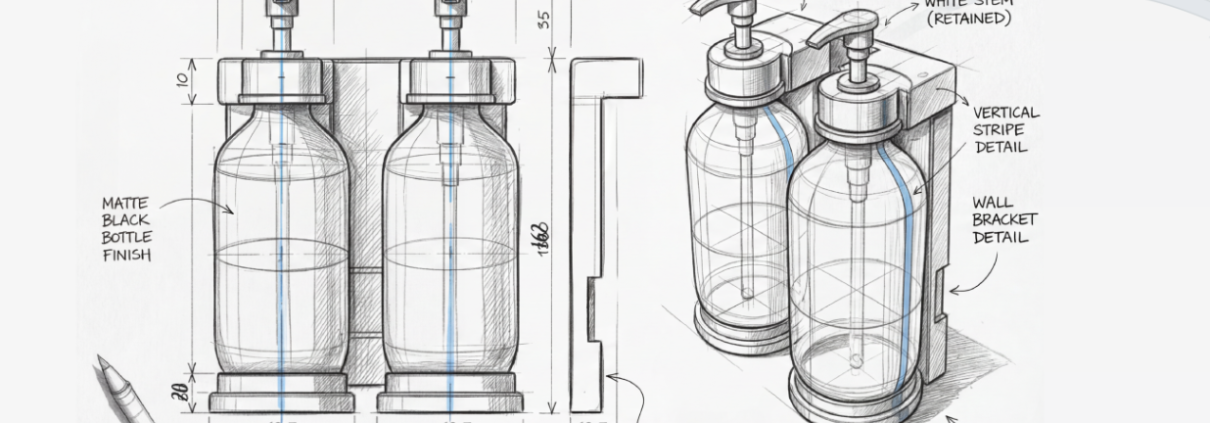
Step 2: 3D Prototyping and Confirmation — Making the Idea “Visible”

Once needs communication is complete, the manufacturer’s design team begins work. The core goal of this step is: before mold development, let you “see” the final product’s appearance and structure.

Prototyping Process:

Design draft creation: Based on your requirements, designers create 2D renderings or 3D models to confirm appearance, color, logo placement, and other visual elements

3D modeling: Engineers build a digital 3D model to confirm dimensions, structure, and assembly relationships

Mockup making (if needed): Use 3D printing or CNC machining to create physical mockups (rapid prototypes) for appearance and assembly verification

Review and feedback: You evaluate the design drafts, 3D models, or mockups and provide revision suggestions

Final confirmation: All details are agreed upon, and the project moves to mold development

For simple projects requiring only logo customization or color changes, this phase takes approximately 3-7 business days. For complex projects requiring entirely new designs, it may take 10-15 business days.

Key confirmation points:

□ Is the appearance shape as expected?

□ Is the color accurate (reference to Pantone color code recommended)?

□ Is the logo position and size appropriate?

□ Do the dimensions meet installation and usage requirements?

Step 3: Mold Development and First Article Confirmation — From Digital to Physical

This step is the most critical in ODM customization and best demonstrates the manufacturer’s capabilities. The mold is the “mother” of product production, and its quality directly determines the final product’s quality.

Mold Development Process:

Mold design: Engineers design the mold structure based on the confirmed 3D model

Mold machining: CNC machining, EDM (electrical discharge machining), etc., to manufacture steel molds

Trial molding: Use the new mold for trial production of a small quantity to verify molding quality and dimensional accuracy

First article confirmation: Ship trial-molded products to the client for final approval

For plastic soap dispensers, the mold development cycle is typically 20-30 business days; for stainless steel dispensers, drawing molds typically take 15-25 business days. Sensor-operated electronic dispensers, which involve electronic component molds, may extend to 40-60 business days.

About mold costs:

If you select an existing product from the manufacturer’s library (ODM selection), there is no mold fee

For new mold development, the mold cost is typically borne by the client, but the mold belongs to the client

Some manufacturers refund the mold fee upon reaching a certain order volume

Leekong’s advantage: We have our own mold workshop and engineering team, enabling efficient mold development and flexible adjustments based on client needs. Compared to suppliers relying on external mold makers, we maintain better control over development timelines and quality.

Step 4: Mass Production — Quality is Made, Not Inspected

After first article approval, the project moves into mass production. This is the most time-consuming phase of the entire process and the critical stage for quality control.

Production Process Flow:

Raw Material Procurement → Injection Molding/Stamping/Casting → Surface Finishing → Assembly → Functional Testing → Packaging

Detailed Breakdown by Process:

Process Plastic Soap Dispensers Stainless Steel Dispensers Sensor-Operated Electronic Dispensers
Raw Materials ABS/PP plastic pellets 304 stainless steel sheets Plastic/metal + PCB
Forming Process Injection molding Drawing/stamping Injection molding + SMT assembly
Surface Finishing Painting/Plating/Silk-screen Brushing/Polishing/PVD Painting/Plating
Assembly Manual + semi-automated Manual assembly Assembly line + functional testing
Testing Appearance/Function sampling Appearance/Function sampling 100% functional testing


Quality Control System (QA & QC)

Rigorous quality control ensures product consistency. We have inspection checkpoints at every stage of production:

  • Incoming Quality Control (IQC):All raw materials are inspected before entering the warehouse to ensure plastic pellets, stainless steel sheets, electronic components, etc., meet specifications
  • In-Process Quality Control (IPQC): Sampling during production to detect anomalies early and prevent defective products from moving to the next stage
  • Final Quality Control (FQC):Functional testing and appearance inspection before packaging
  • Outgoing Quality Control (OQC):Final inspection before shipment to ensure each batch meets quality standards

Production Timeline Reference:

Standard products: 15-25 business days

Customized products (with logo, color): 25-35 business days

New mold development: 30-45 business days

Step 5: Quality Testing and Certification — Ensuring Global Compliance

Before products leave the factory, ensuring they meet target market regulations and certification requirements is crucial. This is a key distinction between professional manufacturers and ordinary factories.

Key Certifications:

Certification Target Market Applicable Product Types Requirement
FDA United States Products contacting skin/liquids Material safety, no harmful substance leaching
REACH European Union All products No Substances of Very High Concern (SVHC)
RoHS European Union Electronic products Restriction of lead, mercury, cadmium, etc.
LFGB Germany Food-contact products German food and commodities safety standards
ISO 9001 Global All products Quality management system certification

Leekong’s advantage: We provide products compliant with FDA, REACH, RoHS, and other international standards, and can provide corresponding certification documents upon request. For the PCBA design of sensor-operated dispensers, we also support full BOM/Gerber file delivery, ensuring clients have complete understanding and control of their products.

Step 6: Packaging and Shipment — The Final Mile of Perfect Delivery

After production is complete and quality inspection passed, products move to packaging and shipment. Packaging is not only a means of protecting products but also an important part of the brand experience.

Packaging Options:

Packaging Level Standard Solution Branded Custom Solution
Inner packaging Transparent poly bag Non-woven fabric bag, OPP bag with logo
Intermediate packaging Standard inner box Custom printed color box
Outer packaging 5-layer corrugated carton Custom printed outer carton

Shipping Methods and Transit Times:

Method Best For Transit Time
International Courier (DHL/FedEx/UPS) Samples, small batches 3-7 business days
Air Freight Medium batches, urgent orders 7-12 business days
Sea Freight Large volume orders 20-40 business days

Pre-shipment checklist:

□ Does the quantity match the order?

□ Is the packaging intact?

□ Are labels and markings correct?

□ Are customs documents complete (invoice, packing list, bill of lading, certificate of origin, etc.)?

Part 3: Leekong’s ODM Customization Advantages

3.1 Low MOQ — Let Brands Start Small

Minimum Order Quantity (MOQ) is a major barrier for new brands and small-to-medium clients entering the custom products market. Traditional manufacturers typically require MOQs of 3,000-5,000 units, which is prohibitive for many clients.

Leekong’s MOQ Strategy:

Customization Type Typical MOQ Best For
Laser engraving logo (existing product) 500 units Startup brands, crowdfunding projects
Color customization (existing mold) 1,000 units Boutique hotels, brand customization
New mold development 3,000-5,000 units Premium brands, exclusive product lines


For stainless steel products, our MOQ is even more flexible, starting as low as 100-500 units. This enables boutique hotels, independent brands, and startups to access high-quality custom products.

Real case: A skincare startup needed just 500 soap dispensers for a crowdfunding project. They chose our “semi-custom” solution—existing stainless steel bottle body with laser-engraved logo—easily meeting the MOQ. Their campaign exceeded its funding goal by 340%. Four months later, they reordered 5,000 units.

3.2 Fast Prototyping — Shortening Time-to-Market

In a fast-paced market, speed is competitive advantage. Leekong’s prototyping service ensures you can validate your product design quickly.

Customization Type Sample Lead Time
Logo customization / Color change 7-10 business days
Surface finish customization 10-25 business days
New mold development (mockup + mold) 20-40 business days

Standard prototyping takes approximately 2 weeks, significantly faster than the industry average.

3.3 Flexible Customization — Meeting Diverse Needs

Leekong offers comprehensive customization services from basic to advanced:

  • Logo customization:Silk-screen printing, UV transfer, laser engraving, metal badge inlay
  • Color customization: Pantone color matching, unlimited color options
  • Surface finishing:Brushed, polished, electroplated, PVD, spray coating
  • Packaging customization:Full design for inner boxes, outer cartons, instruction manuals, labels
  • Structural customization: New mold development, exclusive shapes, functional customization

3.4 Dual Production Capability — Expert in Both Plastic and Stainless Steel

We maintain complete dual production lines for both plastic injection molding and stainless steel processing, enabling flexible material selection based on your project requirements. Whether you need large-volume plastic products or small-batch premium stainless steel items, we have proven production experience.

Global clients we’ve served: Marriott, H World Group, Hunter, The Guest Supply — these internationally renowned brands’ trust in us confirms our commitment to quality.

Conclusion

From sketch to finished product, ODM soap dispenser customization is not a mysterious black box but a clear, navigable path. From needs communication to mold development, from sample confirmation to mass production, every step follows established processes and standards.

For brand owners, the greatest value of the ODM model is: turning ideas into marketable products with controllable cost and time. You don’t need to own a factory, understand injection molding processes, or even draw blueprints yourself—you just need a clear idea and a reliable partner.

Leekong is committed to providing high-quality ODM/OEM custom soap dispenser services to clients worldwide, with a complete industry chain from design, molding, production to quality inspection. Whether you want to private-label existing products from our library or develop entirely unique custom products, we offer professional one-stop solutions.

Ready to turn your idea into a product? Contact us, tell us your requirements, and we’ll provide an initial solution within 24 hours

In the world of hospitality, details are everything. The guest experience is a tapestry woven from countless threads—from the thread count of the sheets to the warmth of the welcome. One often underestimated yet crucial thread is the humble bathroom soap dispenser. It’s a point of direct, tactile interaction multiple times a day. The right choice says “quality,” “thoughtfulness,” and “brand consistency.” The wrong choice can lead to frustration, mess, and a perceived lack of care.

Selecting a soap dispenser is not a one-size-fits-all decision. The ideal model for a luxury resort is vastly different from that of a budget-friendly motel. This guide will walk you through the key considerations and provide tailored recommendations for every major hotel category.

Key Considerations Before You Choose

Before diving into hotel types, establish your core criteria:

  1. Durability and Viability: Hotels are high-traffic environments. Dispensers must withstand constant use, occasional rough handling, and frequent cleaning with chemicals. Look for robust materials like cast metal, high-grade ABS plastic, or solid ceramic.
  2. Functionality and User-Friendliness: The mechanism must work flawlessly. Pumps should be smooth and require minimal pressure. Lever mechanisms should be intuitive. Avoid anything overly complicated that might confuse or frustrate a guest.
  3. Capacity and Maintenance: Larger capacities mean fewer refills, saving housekeeping time and labor costs. Opt for dispensers that are easy to open, fill, and clean to streamline operations.
  4. Aesthetics and Design: The dispenser must complement the bathroom’s design ethos. It should feel like an integrated part of the décor, not an afterthought.
  5. Sustainability: Modern travelers are increasingly eco-conscious. Refillable dispensers significantly reduce single-use plastic waste compared to individual miniature bottles. This is not just an environmental choice but a powerful marketing message.
  6. Cost: Factor in the total cost of ownership: the initial unit price, the cost of bulk soap refills, and the long-term maintenance and replacement costs.

Dispenser Recommendations by Hotel Type

1. Luxury & 5-Star Hotels

Guest Expectation: Seamless, elegant, and memorable perfection. Every element should feel premium, bespoke, and exceptionally high-quality.

  • Recommended Type: Wall-mounted, automated (sensor-operated) dispensers or high-end manual pumps.
  • Material: Brushed nickel, polished chrome, bronze, or brass are ideal for a timeless, luxurious feel. For a more modern aesthetic, consider matte black finishes or even crystal/glass accents. Solid ceramics with a high-gloss glaze also convey opulence.
  • Why It Works:

               Sensor-operated models offer the ultimate in hygiene and modern luxury—guests never touch the unit.

The weight and cool touch of metal signal quality and substance.

Look for models with minimal branding or the option for custom engraving of the hotel’s logo for a truly bespoke touch.

  • Product Suggestion: A heavy-gauge stainless steel sensor dispenser with a quiet, precise motor. The design should be sleek and minimalist.

2. Boutique & Design-Led Hotels

Guest Expectation: Unique, Instagram-worthy, and thoughtfully curated. Design is a primary driver of the experience.

  • Recommended Type: This is where you can get creative. Unique manual pumps, sculptural ceramic vessels, or dispensers integrated into the mirror or wall are all possibilities.
  • Material: Almost anything goes: matte ceramics in unique colors, reclaimed wood with a glass reservoir, colored glass, or brushed metals in unusual finishes like copper or rose gold.
  • Why It Works: The bathroom fixture becomes a conversation piece. It reinforces the hotel’s unique narrative and design story. The focus is on aesthetics and creating a cohesive visual theme.
  • Product Suggestion: A hand-thrown ceramic dispenser from a local artist or a geometrically shaped pump in a bold, contrasting color that matches the hotel’s branding.

3. Business & Conference Hotels

Guest Expectation: Efficiency, reliability, and functionality. Guests are often on a tight schedule and value things that work simply and effectively.

  • Recommended Type: Large-capacity, wall-mounted manual lever pumps.
  • Material: Durable, commercial-grade plastic or metal. Finishes should be smudge-resistant like brushed nickel or matte finishes.
  • Why It Works:

              Lever pumps are universally understood and reliable. They have fewer mechanical parts to fail than sensors.

              Large capacity reduces the chance of a dispenser running out during a guest’s stay, minimizing complaints and housekeeping calls.

The aesthetic is clean, professional, and unobtrusive.

  • Product Suggestion: A 1000ml+ capacity dispenser with a metal lever and lockable, easy-fill reservoir. It’s a workhorse designed for performance and durability.

4. Resort & Spa Hotels

  • Guest Expectation: Relaxation, wellness, and immersion in a natural or serene environment. The experience should feel nurturing and holistic.
  • Recommended Type: Wall-mounted manual pumps or sensor models that evoke a spa-like feel.
  • Material: Natural materials are key. Think bamboo, teak wood, stoneware, or pebble-shaped ceramics. Soothing, earthy tones like sand, grey, and soft green work well.
  • Why It Works: Materials like bamboo are sustainable and directly connect to a natural, calming aesthetic. The design should feel organic and soft, avoiding harsh lines or industrial looks. The soap itself is often a premium, aromatherapeutic blend.
  • Product Suggestion: A dispenser with a bamboo housing or a smooth, river-stone-shaped ceramic pump. Sensor models here should be nearly silent to maintain the tranquil atmosphere.

5. Budget & Limited-Service Hotels

Guest Expectation: Cleanliness, value, and practicality. The priority is providing a functional, hygienic, and cost-effective solution.

  • Recommended Type: Simple, lockable wall-mounted pumps or integrated dispenser systems (combined shampoo, conditioner, body wash).
  • Material: High-impact, durable ABS plastic.
  • Why It Works:

            Cost-effectiveness is paramount. These units are affordable to purchase and replace.

            Combined 3-in-1 systems save space, reduce installation points, and simplify the housekeeping process.

Locking mechanisms prevent tampering and waste.

They offer the significant sustainability and cost-saving benefits of bulk amenities over single-use bottles.

  • Product Suggestion: A simple, white or neutral-colored lockable plastic pump with a clear reservoir for easy monitoring of soap levels.

6. Eco-Friendly & Sustainable Hotels

Guest Expectation: Authentic commitment to environmental practices. Every choice must reflect this core brand value.

  • Recommended Type: Dispensers made from recycled or highly sustainable materials. Refill models are a must.
  • Material: Post-consumer recycled plastic, reclaimed wood, bamboo, or aluminum (highly recyclable).
  • Why It Works: It validates the hotel’s mission. The story is important—guests will appreciate knowing the dispenser is made from 100% recycled ocean plastic or sustainably sourced bamboo. This choice aligns with the bulk-fill model, which is the most significant way to reduce amenity waste.
  • Product Suggestion: A dispenser certified by a sustainability organization, made from 100% recycled materials, and paired with a vegan, cruelty-free, and biodegradable soap formula.

Final Checklist for Procurement

  • Test the Mechanism: Order a sample. Is the pump smooth? Is the sensor responsive?
  • Check Refill Availability: Ensure the bulk soap you plan to use is compatible with the mechanism to avoid clogs.
  • Consider Installation: Do you need a professional to drill into tile? Are there adhesive options for surfaces you can’t drill?
  • Plan for Maintenance: Train housekeeping on proper refilling and cleaning procedures to ensure longevity.

Conclusion

The soap dispenser is a small fixture with a big job. It is a functional tool, a design element, and a communicator of your brand’s values. By carefully selecting a dispenser that aligns with your specific hotel type, target guest, and operational needs, you invest in an detail that elevates the entire guest experience, proving that true luxury and quality are always in the details.

Best Western and the Evolution of Hotel Amenities: The Case of Disposable Soap Dispensers

Introduction

The hospitality industry is constantly evolving, with hotel chains striving to enhance guest experiences while maintaining operational efficiency and sustainability. Among the leading global hotel brands, “Best Western” has established itself as a trusted name, offering consistent quality and comfort across its properties. One of the critical yet often overlooked aspects of hotel operations is the provision of “hotel amenities”, particularly “disposable soap dispensers”.

In recent years, the shift from single-use toiletries to bulk dispensers has been a significant trend, driven by both environmental concerns and cost efficiency. However, the debate between “disposable soap bottles” and “refillable dispensers” continues, with brands like “hotel soap dispenser supplier” emerging as key players in the hospitality supply chain.

This blog post explores “Best Western”s approach to hotel amenities, the role of “disposable soap dispensers” in modern hospitality, and how hotel soap dispenser supplier companies are influencing the industry.

  1. Best Western Hotel Group: A Brief Overview

1.1 History and Growth

Founded in 1946, Best Western began as a small network of independent hotels in the United States. Unlike traditional hotel chains, Best Western operated as a non-profit membership association, allowing independent hoteliers to maintain ownership while benefiting from collective branding and marketing.

Over the decades, Best Western expanded globally, now operating over 4,700 hotels in more than 100 countries. The brand has diversified into multiple tiers, including:

– Best Western (mid-scale)

– Best Western Plus (upper mid-scale)

– Best Western Premier (upscale)

– BW Signature Collection (boutique-style)

– Executive Residency by Best Western (extended-stay)

1.2 Commitment to Sustainability and Guest Comfort

Best Western has consistently adapted to industry trends, including eco-friendly initiatives. The hospitality sector has faced increasing pressure to reduce plastic waste, leading many hotels to reconsider their amenity strategies.

While some luxury chains have opted for high-end, branded mini-toiletries, budget and mid-scale hotels like Best Western have increasingly turned to bulk soap dispensers to minimize waste and costs. However, the debate over disposable vs. refillable soap bottles remains relevant.

  1. The Role of Hotel Amenities in Guest Experience

2.1 Why Amenities Matter

Hotel amenities play a crucial role in shaping guest perceptions. Items such as soap, shampoo, conditioner, and lotion may seem trivial, but they significantly impact comfort and satisfaction.

– Convenience: Guests expect basic toiletries to be provided.

– Brand Image: High-quality amenities enhance perceived value.

– Hygiene: Especially post-pandemic, guests prefer sealed or single-use products.

2.2 The Shift from Mini-Bottles to Dispensers

For years, hotels relied on single-use plastic bottles for shampoos and soaps. However, due to environmental concerns (millions of mini-bottles end up in landfills yearly), many cities and countries have banned them.

Best Western, like other chains, has explored alternatives:

– Refillable wall-mounted dispensers (more sustainable but raise hygiene concerns).

– Disposable soap bottles with pump dispensers (a middle-ground solution).

This is where companies like hotel soap dispenser supplier come into play, supplying hotels with cost-effective, hygienic, and eco-conscious amenity solutions.

  1. Disposable Soap Dispensers: Pros and Cons

3.1 What Are Disposable Soap Dispensers?

Unlike traditional mini-bottles, disposable soap dispensers are larger pump bottles designed for single-room use. They hold more product, reducing the frequency of replacement, but are still discarded after each guest’s stay (or after a certain period).

3.2 Advantages

Reduced Plastic Waste (compared to mini-bottles, fewer are used per stay).

Cost-Effective (bulk purchasing lowers expenses).

Hygienic (guests prefer unused, sealed products).

Branding Opportunities (custom labels enhance professionalism).

3.3 Disadvantages

Still Not Fully Sustainable (they are thrown away eventually).

Potential for Theft or Waste (guests may take entire bottles).

Refill Challenges (some hotels prefer refillable systems for long-term savings).

3.4 Best Western’s Approach

Best Western properties vary in their amenity strategies. Some franchisees use refillable dispensers, while others opt for disposable pump bottles to balance hygiene and cost. The brand encourages eco-friendly practices, but final decisions often rest with individual hotel owners.


  1. hotel soap dispenser supplier: A Key Player in Hotel Amenity Supply

4.1 Who Is hotel soap dispenser supplier?

hotel soap dispenser supplier is a manufacturer and supplier specializing in hotel amenities, including:

– Disposable soap dispensers

– Shampoo & conditioner bottles

– Dental kits

– Other guest essentials

The company serves budget to mid-scale hotels, providing affordable yet presentable solutions.

4.2 Why Hotels Choose hotel soap dispenser supplier

– Cost Efficiency: Bulk purchasing reduces per-unit costs.

– Custom Branding: Hotels can add logos for a professional touch.

– Hygiene Compliance: Sealed disposable bottles reassure guests.

– Regulatory Adaptation: Helps hotels comply with plastic bans.

4.3 hotel soap dispenser supplier’s Impact on Best Western

Many Best Western franchisees source amenities from suppliers like hotel soap dispenser supplier due to their competitive pricing and reliability. As the hospitality industry moves toward sustainable yet practical solutions, partnerships with such suppliers will remain crucial.

  1. The Future of Hotel Amenities: Trends and Predictions

5.1 Biodegradable and Refillable Solutions

The next evolution may involve:

– Plant-based disposable bottles (compostable materials).

– Smart dispensers (monitor usage to prevent waste).

– Water-saving formulations (concentrated soaps).

5.2 Guest Preferences Shaping the Market

Surveys indicate that:

– 65% of travelers prefer sustainable amenities.

– Yet 40% still prioritize hygiene over eco-friendliness.

This duality means hotels like Best Western must strike a balance.

5.3 Best Western’s Potential Moves

– Standardizing eco-policies across franchises.

– Partnering with green suppliers for innovative solutions.

– Educating guests on sustainability efforts.

Conclusion

The discussion around hotel amenities, particularly disposable soap dispensers, reflects broader industry challenges: sustainability vs. convenience, cost vs. quality, and hygiene vs. environmental impact.

Best Western, as a global mid-scale leader, must navigate these factors while maintaining guest satisfaction. Suppliers like hotel soap dispenser supplier play a pivotal role by offering practical, affordable solutions that align with evolving regulations and consumer expectations.

As the hospitality sector continues to innovate, disposable soap bottles may eventually give way to even greener alternatives. However, for now, they remain a key component of hotel operations, ensuring both guest comfort and operational efficiency.

For hoteliers, the lesson is clear: adaptability is essential. Whether through refillable systems, biodegradable disposables, or smart dispensers, the future of hotel amenities will be shaped by technology, sustainability, and guest demand.

Would you like additional insights on specific Best Western locations or amenity suppliers? Let me know in the comments!


Leekong Hotel bathroom soap dispenser manufacturer, accepts ODM&OEM and unique customization services

The End of the $800 De Minimis Rule: What It Means for Businesses, Hotels, and Consumers Introduction

Former U.S. President Donald Trump announced plans to terminate the de minimis rule, which allowed imported goods valued under $800 to enter the U.S. without tariffs or extensive customs scrutiny. This policy change has far-reaching implications for businesses, particularly those reliant on low-cost imports—such as hotels stocking soap dispensers and other amenities.

The change to the “de minimis” exemption was first implemented on goods from the Chinese mainland and Hong Kong in May, as China is the largest source of these shipments.

Low-cost online stores like Shein and Temu, both extremely popular with shoppers in the US and worldwide, were among those that would likely be directly affected, warned Z. John Zhang, a professor of marketing at the Wharton School of the University of Pennsylvania.

But Zhang told China Daily that the recent rule change will also hit many other businesses in China that do business with the US, as it’s “not just fast fashion in this case, it’s really all kinds of goods under the value of $800”.

This policy has had an impact on many manufacturers in China, such as Leekong, a Chinese manufacturing tycoon whose company supplies millions of soap dispensers to American hotels. With the de minimis loophole closed, businesses like his will face higher costs, logistical hurdles, and potential shifts in supply chains.

In this blog post, we’ll explore:

– The history and purpose of the de minimis rule

– Why Trump moved to eliminate it

– The impact on hotels, soap dispenser suppliers, and manufacturers like Leekong

– Alternative strategies for businesses to adapt

  1. What Was the De Minimis Rule?

The de minimis threshold (Latin for “minimal things”) allowed shipments valued at less than $800 to enter the U.S. tax-free and with minimal customs checks. Established under the Trade Facilitation and Trade Enforcement Act of 2015, this rule was designed to:

– Speed up e-commerce deliveries (e.g., Amazon, AliExpress, Wish)

– Reduce administrative burdens on small businesses and customs

– Encourage cross-border trade, particularly from China

For years, companies—especially those importing small, low-cost items like soap dispensers, toiletries, and electronics—relied on this rule to keep costs low.

Key Impacts of the De Minimis Rule Termination

  1. E-Commerce & Small Businesses

Higher Costs for Consumers: Online shoppers will pay $80–$200 extra per international order.

Small Businesses Squeezed: U.S. and Canadian sellers (e.g., Etsy shops) lose cost advantages, facing new paperwork and delays.

Chinese E-Commerce Giants Hit: Temu and Shein, which relied on direct-to-consumer shipping, must restructure supply chains or absorb 54–120% tariffs.

  1. Hotels & Soap Dispenser Suppliers

Bulk Importers Face Tariffs: Hotels sourcing cheap soap dispensers, toiletries, and linens from China will see 25%+ cost increases.

Supply Chain Shifts: Manufacturers like Lee Kong may relocate production to Vietnam or Mexico to avoid tariffs.

  1. Global Trade & Geopolitical Fallout

China’s Export Model Disrupted: The $800 loophole was a key enabler of China’s “white-label” e-commerce boom.

U.S. Inflation Risks: Low-cost goods (e.g., $7 T-shirts, $60 board games) will become more expensive.

Trade War Escalation: The move intensifies U.S.-China tensions, alongside existing 24% suspended tariffs.

  1. Why Did Trump End It?

Trump’s decision to scrap the $800 exemption aligns with his broader “America First” trade policies, including:

– Tariffs on Chinese goods (starting in 2018)

– Crackdown on customs loopholes that benefited foreign manufacturers

– Encouraging domestic production over reliance on imports

Key Reasons for Termination:

Preventing Abuse: Many Chinese sellers (including Leekong’s soap dispenser empire) exploited the rule by shipping bulk orders in small, separate packages to avoid tariffs.

Protecting U.S. Manufacturers: Domestic producers argued that the rule gave foreign competitors an unfair advantage.

Revenue Generation: The U.S. government loses billions in potential tariffs annually due to de minimis exemptions.

  1. Impact on Hotels & Soap Dispenser Suppliers
  2. Higher Costs for Hotels

Hotels rely on cheap, bulk-purchased amenities—soap dispensers, shampoos, towels—often imported from China. Without the $800 exemption:

– Prices per unit will rise (due to tariffs + customs fees)

– Supply chain delays (more inspections = slower deliveries)

– Possible switch to domestic suppliers (but at higher costs)

Case Study: Leekongs Soap Dispenser Business  

Leekong’s company supplies millions of soap dispensers to U.S. hotels annually. Under the old rule, he could ship hundreds of small packages tariff-free. Now:

– Each shipment may incur 25%+ tariffs (Trump’s China rates)

– Profit margins shrink, forcing price hikes

– Competitiveness drops vs. U.S.-made alternatives

  1. Shift in Supply Chains

Some businesses may:

– Relocate production to tariff-exempt countries (Vietnam, Mexico)

– Stockpile inventory before full policy enforcement

– Invest in automation to offset rising costs

  1. How Businesses Can Adapt
  2. Alternative Sourcing Strategies

– Nearshoring: Partner with Mexican or Central American suppliers.

– Diversify Suppliers: Avoid over-reliance on China (e.g., look to India, Thailand).

– Bulk Shipping: Consolidate orders to reduce per-unit tariffs.

  1. Lobbying & Policy Influence

– Industry groups (e.g., American Hotel & Lodging Association) may push for exemptions.

– Legal challenges could delay enforcement.

  1. Passing Costs to Consumers  

– Hotels may charge higher rates or cut back on free amenities.

– E-commerce sellers (Amazon, eBay) will raise prices.

  1. Conclusion: A New Era for Trade

The end of the $800 de minimis rule marks a significant shift in U.S. trade policy—one that benefits domestic manufacturers but strains import-dependent businesses. For hotels, soap dispenser suppliers like Lee Kong, and e-commerce sellers, adaptation is crucial.

Will companies absorb the costs, pass them to consumers, or relocate production? Only time will tell. One thing is certain: global trade will never be the same.

Final Thoughts

In fiscal year 2024, $64.6 billion worth of goods in over 1.36 billion small shipments were utilized de minimis, according to Yale University and US Customs and Border Protection.

Now, all countries that send items to US customers or businesses outside of the international postal network will be subject to the rule change starting on Aug 29, Trump’s executive order stated on Wednesday. Trump’s de minimis termination reshapes global e-commerce, forcing businesses to rethink supply chains, pricing, and market strategies. While it protects U.S. manufacturers, consumers and small importers face higher costs and delays.

Will this policy backfire by fueling inflation? Or will it successfully bring manufacturing back to America? The answer may determine its political and economic legacy.

– For consumers: Expect higher prices on small imported goods.

– For businesses: Rethink supply chains and pricing strategies.

– For policymakers: Balance protectionism with economic efficiency.

What do you think? Will killing the de minimis rule help or hurt the U.S. economy? Let’s discuss in the comments!

Portfolio Items